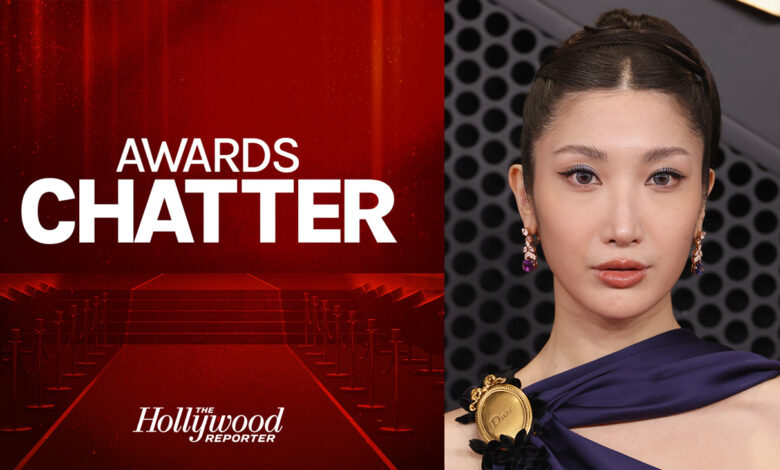
For EJAE, the Korean-American singer/songwriter who is the guest on this episode of The Hollywood Reporter’s Awards Chatter podcast, which was recorded in front of film students at Chapman University, 2026 — like 2025 before it — is shaping up to be truly, well, golden.
In 2025, “Golden,” the banger tune that she co-wrote for the Netflix animated film KPop Demon Hunters — for which she also provided the singing voice for the character Rumi, one third of the girl group at its center, Huntrix — became a worldwide phenomenon, shooting to No. 1 on the Billboard Hot 100 and holding that spot for eight weeks. It marked the first time that a K-pop — or Korean popular music — act not associated with BTS had ever topped the Hot 100, and it made Huntrix the first girl group to top it since Destiny’s Child with “Bootylicious” back in 2001. The film, meanwhile, became the most watched original title in Netflix’s history, accumulating more than 500 million views.
For the 34-year-old born Eun-jae Kim, things have only continued to explode in 2026. In January, “Golden” was awarded the best original song Critics Choice and Golden Globe awards, while KPop Demon Hunters won those shows’ best animated feature prizes. On Feb. 1, “Golden” was recognized with the Grammy for best song written for visual media, the first Grammy ever awarded to K-pop. And on March 15, it is widely expected that “Golden” will take home the best original song Oscar and KPop Demon Hunters will take home the best animated feature Oscar.
Over the course of this episode, which you can listen to via the player above or read via a lightly-edited transcript below, EJAE — who dropped a new single, “Time After Time,” on Feb. 6 — reflects on her early pursuit of a career as a K-pop idol and the crushing way in which it failed to pan out; what led her to pivot to songwriting; how she came to be involved with KPop Demon Hunters, and how “Golden” evolved from a melody she hummed into her iPhone into a global phenomenon; plus much more.
* * *
Welcome. Thank you for being here. We’re so excited to have you.
Oh my God! Thank you for having me. Hello. Wow.
Tonight we are going to go in-depth about “Golden,” but first I think people would like to learn more about you. Can you share where you were born and raised, and what your folks did for a living?
That’s a complicated one. I lived half my life in Korea and half my life in the States. I was born in Seoul, Korea, because my mom was on vacation. When I was six months old, which was the legal age to travel back on a plane, I came back to New Jersey, which is where I lived. I stayed there ’til I was eight, then came back to Korea, then stayed there ’til high school, graduated, went to NYU, stayed in New York, and then went back to Korea.
What was your name at birth?
Eun-jae Kim.
When and how did ‘EJAE’ come about? Was that a childhood nickname?
I would introduce my name and people couldn’t really pronounce it. So I just went by EJAE.
What kind of music were you listening to as a kid? Was it kind of a mix of both cultures’ music, or were you leaning towards one?
Definitely a mixture of both cultures. My first love was definitely K-pop. That’s when I kind of figured out, “Oh, I want to be a singer.” I loved the first generation like H.O.T. and g.o.d. It was before K-pop was called K-pop.
When did K-pop blow up?
That’s a great question. I think probably it was starting to get into the States with Psy coming in with “Gangnam Style.” That became pretty popular. And then BTS, obviously. Blackpink got really big too. So yeah, it was really interesting to see how it got into the mainstream world.
If we tracked down your classmates from grade school, would they remember you as a very musical kid? Or was that something that only came later?
Oh, 100 percent. I think everyone at school knew I was, essentially, “the singer.” My school was really small. I went to SFS, Seoul Foreign School, in Korea. It’s a very small, missionary-based school. We had like 100 kids in our class. I would do all the theater stuff or a cappella groups. I would be the leader and figure out all the harmonies and stuff.
How early on did songwriting enter the picture? Most kids cover the songs they love. Were you also writing stuff?
Not at all. No, because my goal was to be a K-pop idol, and K-pop idols didn’t really write songs. So songwriting was really random for me, actually. I never thought I would ever be a songwriter. That was never in my list. My dreams were like, makeup artist, criminal lawyer and singer, that’s it. Not songwriter.
In 2003, when you were 11, what happened in your life that really shook things up?
That’s when I got into SM Entertainment. Before that, I was auditioning a lot. SM was nice enough to accept me.
Would you mind explaining, for people who don’t know, what SM is? It was kind of the place, right?
Yeah. I would say that Korea had, at that time, three top record labels: SM, JYP and YG. And they would produce huge K-pop idols and artists. At that time, SM was on the top of their game. My favorite K-pop idols were at SM as well. BoA, Dong Bang Shin Gi, which is TVXQ, and H.O.T. were from SM, so that was always my dream place to go.
When you signed with them, did that mean leaving your school and daily life, or was what you did with them on top of a normal kid’s life?
Well, it depends on the person. I know a lot of the trainees were cast in the States, so they would have to come to Korea. I don’t know if they went to school — some kids did, but they would have dorms for them. But for me, I lived in Korea as well, so it was convenient for me — I would just go after school. However, with SM, being a trainee is a job. So if there were showcases or anything important, I would have to skip school.
It was sort of a star factory, a K-pop idol factory. How long would somebody be being developed there?
It really depends. Debuting within a year is really rare. For some people six months. But usually the average would be like three to five years.
And what would happen then?
They would either put you in a group or terminate the contract, it was quite black and white like that. What we would learn at these labels was a lot of rigorous training for dancing, singing, Chinese, acting. It’s a whole program for everything, to essentially train you to become a worldwide superstar. They actually also checked our grades, because we’re Asian. (Laughs.) They made sure we didn’t fail class.
Because it’s a big part of your story now, can you share how things with SM came to a head for you?
Yeah. So I got in when I was 11, and I learned a lot of things. I trained really hard. Around the time I went, it was a lot smaller. There were only like 20 to 30 people. Now they have like 80 people, it’s quite big now. But back then I was training with Girls’ Generation and Super Junior. We would have a whole schedule for the week, with dance class and all that, and usually it would end at around 3:00 to 4:00 p.m. I noticed a lot of those trainees would just go home, but I was like, “You have this whole facility, let’s practice.” And so I remember practicing a lot because I wanted to be the next BOL4 — essentially a Korean Beyoncé. I was first one there at 8:00 a.m. and then left at like 11:00 p.m., turning off all the lights. When I look back now, I’m like, “Wow, that little girl really worked hard.” I can’t believe it even now — her work ethic at that time was just beyond even my work ethic now. But you would have to do showcases and after the showcases they would rank us. That was kind of our test, to see if we would go to the next stage of pre-debuting. And I would always fail at that, always be critiqued or rejected. As a kid, it’s quite hard to hear, being critiqued. And I just always felt like no matter how hard I worked, things never really worked out for me. I stayed there for a long time. I felt very dejected.
What was the feedback that you were getting at the time?
A lot about my singing, the way I sang. My singing was a little too “old” sounding or low. Or my dancing felt heavy. They would also talk about physical appearance and stuff. It’s a business, so I understand, but it wasn’t easy.
Was there actually, though, a moment where they were like, “This isn’t going to work out with us,” or was there just kind of a sense that it was time to focus on other things?
I wanted to have a college degree. That was very important to me. So I applied to NYU. And I was supposed to actually debut at the time — a Japanese girl, a Chinese girl, and me were supposed to be this three-member girl group, like Huntrix, and be a ballad girl group, but it never happened. Then, after I graduated, I came back and trained a little more. And then they basically put me through the training again, and they had a final meeting, and I remember waiting for like a week to hear the result. And I still remember, I was at a cafe in Seoul, and basically the result was, just to be plain and simple, I wasn’t a good enough singer, I wasn’t a good enough dancer, I was way too old, and I was also too tall. And so the result was just, “I don’t think this makes sense, business-wise.” And actually, right now, I completely understand, to be honest.
How did you feel at that time?
I was really, really sad. There’s these theories that when you are about to die, you have these memories that just flood you, right? That’s how I felt at that moment. My dreams that I had, all the hard work that I did as a kid, from 11 ’til 22, just felt like a waste. I was in a cab, and it was raining that day, and just looking up, you know how raindrops on glass look like teardrops? Yeah, it was like a movie scene. I was very numb. And very plain and simple, just depressed.
How then find your way to doing something that you thought you were never going to do, which was songwriting?
It was such a beautiful accident. During the time I was with SM, at the end of it all, I really got into the underground scene in New York and L.A., the SoundCloud scene. It was really big back then — like Soulection, Kaytranada, Mr. Carmack, Sángo. Self-producing and home recordings were all really big back then, so I started studying that by myself, and me with my ex at the time were kind of into the production. So we would go to Dubstop, and I would teach myself how to produce. That’s when my sound and SM also clashed. After that, I was just into making beats, to be honest. I did not know what the hell I was doing, but I just went with my gut, whatever made me feel better. And then, fast-forward to when I was like 24, this person cast me to start acting, maybe. She was like, “In order to be a singer, you should start focusing on singing OST [original soundtrack] songs for K-dramas.” And I was like, “OK.” So I was singing a song that this producer wrote, and during break time he was like, “What do you do? Do you write?” And I was just like, “I make beats.” And he heard one of my beats and he was like, “Oh!” Because at that time that SoundCloud sound was not in Korea. So it fascinated him and he was like, “Come to our studio tomorrow.” I came and I thought we were going to make beats together, but no. He was like, “Hey, here’s a track, make a melody and write a song over it.” And I was like, “OK, let’s try.” He was like, “Oh, it’s like a K-pop song.” I had this love-hate relationship with K-pop at that time, right? So I was just trying to figure out what K-pop sounded like to me. He was like, “Write about anything.” So I was like, “OK, I’m going to write about my breakup with my ex at that time.” And then just wrote the song, and it was the first song I’ve ever written, literally, other than class work. It was so cathartic. It was such a weird feeling. That night, the producer called me and was like, “By the way, your song’s going to get cut for Hani from EXID.” She was quite a big artist at that time, but I did not know what that meant. But then the song got through, and got picked for her single, and that’s when I was like, “You can make money from writing about heartbreak? Cool!”
Was there any kind of structured way of doing that? Like, when you want to be a singer, you go through SM. But when you want to be a songwriter, if this guy’s not calling you up to come over and make beats, what happens?
That song got cut and released, and I met Andrew Choi — who’s actually the singing voice of Jinu [in KPop Demon Hunters] — and he wrote a lot of SM songs. We had kind of a connection because of SM. I remember we talked for like five hours at a coffee shop just about SM and our songwriting, singing and careers. He had heard that song and was like, “Do you want to write?” That’s when I was like 25, 26. And we just started writing. It was honestly just organic in how it happened. When he said that, I was like, “Yeah, I want to write. That’s so cool.” I was making beats. I never thought I’d be able to write. But the fact that I was able to get a song cut, I was like, “Oh, maybe I have something.” The imposter syndrome kind of went away. I was like, “You know what? If the singing’s not going to work out, I like this.” And I also realized then that everything happens for a reason. I don’t think K-pop idol life would have fit with my personality. I mean, this might sound dark, but I don’t know if I would be able to handle it, genuinely, if I went through that route. I’ve lost friends from it, and I understand where they were coming from. So yeah, I think it, in a way, saved me — songwriting truly saved me in so many different ways. And that’s how my career started. Andrew is the sweetest guy, and he was my mentor. He brought me into my first SM song camp when I was like 25, 26, and that’s when I wrote “Psycho” for Red Velvet.
Many people don’t realize how long a film can be in development — KPop Demon Hunters was seven years from pitch to screen. How early on did you first hear about it?
I first heard about KPop Demon Hunters at the end of 2019. Daniel Rojas is a friend of mine, who actually was on the project before me, and he’s the one who kind of brought it up to me. And I was very excited. It was like, hush-hush: “There’s this project that’s happening, and it’s the first animated, big-budgeted film based in Korea.” And that was just like, “What?!” And he was like, “Nothing official. I’m not saying anything. I’m just saying there is something. Maybe you can be a part of it, but who knows?”
And we should just underscore: you had never been involved with any film project before, right?
No, no, no.
This one had two co-directors, Maggie Kang and Chris Appelhans. When did you first hear from them? Because that made it real, right?
I think what happened was in 2019 or 2020, “Psycho” came out, and that was a huge hit in Korea, and they were talking about bringing me in maybe, and then COVID happened, and that kind of shifted things. Towards the middle or end of 2020, they officially brought me in to the Zoom meetings, and basically asked me and Daniel to write some songs that they were envisioning for some scenes. And that was the intro song and the mantra [“Prologue (Hunter’s Mantra)”].
And that was being used almost as demos to pitch the movie, right?
Yeah, exactly. It wasn’t like, “You’re hired for the whole movie.” It was just kind of like, “Let’s find some songwriters and producers who can maybe help translate this vision that we have into music form, while we pitch this film.”
Take me from that through the rest of your association with the movie.
After that, we got really good feedback. They loved it. And so they continued to work with me and Daniel for another year or two. They started pitching us, like, “How would the boy band sound for the “Soda Pop” scene, right? They asked us for that one, too. And, “How would the duet sound? Can you make a song for that?” Or the finale song. We were kind of testing how things would sound in general. I would write these demos and while doing this, I was also starting my official K-pop songwriting career too, because of “Psycho.” So I was growing as a writer, while also writing for the film. I think that’s kind of when they realized, “Oh wow, her demos are very [good].” I put a lot of pride in my demos, because K-pop demos are very polished. You have to like, finish it. And then our amazing executive music producer, Ian Eisendrath, came into the picture, and then BLACKLABEL came in, and Jenna Andrews, Stephen Kirk and Lynn Grimm started coming in slowly, one by one. And Mark Sonnenblick came in also. They officially brought me in around that time.
When you were brought in, was it also raised that you — the person who supposedly has issues with her singing voice, which we all know now is bullshit — might also provide the singing voice of Rumi in the movie?
It was 2022.
OK. And were you immediately sold on that idea?
No. I remember writing these songs in the very beginning and I was just having fun with, because they were all on Zoom sessions, and we were just joking and Daniel was like, “Haha, wouldn’t it be funny if you were Rumi?” I’m like, “That’d be hilarious. Hope it never happens, because these songs are hard!”
Well, that’s right. You were writing really hard-to-sing songs.
Intentionally, yeah. When they asked me, I was like, “Are you sure?!” Because I was, honestly, really insecure of my voice. Around that time, I did perfect vocal producing and had a great vocal chain that my fiancé helped me make, but still, I was very insecure. When I would work with these songwriters they would be like, “You have an incredible voice,” and I thought that was their way of being like, “You should sing the demo.” Like, “I don’t have to.” I thought about it and I was like, “Well, it’s an animated film. I’m passionate about it. The first animated film based in Korea? Let’s do it. I don’t have to be onscreen.” That was the thought. Also, it was very efficient, because as a songwriter I’m singing all the demos, and these demos are very fleshed out, so I’m confident I can sell the song, since I co-wrote them as well and the melodies. I wrote the melodies with some of the songs. I was just like, “Why not? I can just vocal direct myself, with Ian.”
At the end of the day, you wrote all the Korean lyrics in the movie, except for “Soda Pop.” And you wrote or co-wrote five songs. Give us a quick reminder, if you would, of which those were.
I co-wrote “How It’s Done,” “Your Idol,” and “The Hunter’s Mantra,” and I also was part of the arrangement and melody of the end of “What It Sounds Like.”
And the last one that you wrote-
Was “Golden.”
Why was that the last one?
That was such an important song. It was what Ian would say is the “I want” song — like, in Frozen, “Let It Go” is the “I want” song. Because there was so much pressure with that, you really needed to get that right. Also, I think Ian told me that they were trying to figure out the story, as well. Honestly, these songs were written based on how the story was going. So if they weren’t finished with that part, we were not writing about it. I think they figured out that part, and then it was interesting because we had so many different writers, and they would kind of audition for that scene, right? But the directors would say, “Hey, can you try it?” “Oh, how about you try it?” And hear different songs. I would actually sing the demos of songs I didn’t write that were also for that scene. And Maggie and Chris were kind enough to give us [EJAE and Sonnenblick] the opportunity to write a song for that scene, and that’s how “Golden” happened.
Ian Eisendrath, the executive music producer on the film, is the one that first thought that you and Mark Sonnenblick should work together. You and Mark come from pretty different backgrounds. Can you talk about what his background is, and why you think Ian felt you guys should collaborate?
There had to be pop songs that could stand alone, but also be part of the storyline. I come from a pop songwriting background, but I’d never really written for a film. And having storyline is so important, and there’s language and lyrics that help drive the story in a film, so I think that’s where Mark came into the picture. He’s in the theater, and he’s very much an expert at that, so he came especially for lyrics. I come from pop-writing lyrics and he comes from theater-writing lyrics, so that was really difficult, trying to find this hybrid. But essentially it was perfect.
Were you guys literally in the same place when you were writing together, or would you go back and forth?
It was 2023, I’m pretty sure, when he came in, and I remember meeting him on Zoom. Ian’s like, “Hey, he’s going to help with the lyric writing, to make sure that the songs within the story drive the story.” We were talking and Mark was like, “Where do you live?” I’m like, “New York.” He’s like, “I’m in New York. Where?” “I’m in Brooklyn.” “I’m in Brooklyn.” And then literally, “You want to meet right after our Zoom meeting?” And I was like, “Wait, where do you live?” And it was literally 15 minutes away. I was like, “OK.” Hung up, went right to his place, and we started writing immediately. We wrote the intro song together at that time, which is the “How It’s Done” scene.
With “Golden,” Chris and Maggie have said they gave you certain goalposts that you had to stay within and things you had to include. What were you told?
Maggie and Chris and Ian would definitely give us a very long list of guidelines of what needed to be said, what each character had to express, what each of the characters were like, what was their “I want”? And also, “Melodically, we want something like this. We want something catchy. We want something actually scaling up that we can use throughout the film, that kind of is a metaphor to Rumi reaching for a goal, reaching for a dream that feels so unreachable. And it has to be this impossible note that she will keep cracking throughout the film, and not able to reach, because she’s singing a song that’s not her real voice.” And so that was all in the guidelines. And it had to be catchy. That was just kind of where we started. And Maggie was always like, “Don’t make it sound too musical,” that was always her thing.
“Musical,” meaning like Broadway showtunes?
Like Broadway showtunes. And I love musicals, by the way, but if you translate it into pop, it sometimes doesn’t really work out. It can sound so on the nose sometimes, or too wordy. Whereas with pop music, it has to be catchy, so it has to be concise. And so I think that was always why Mark and I worked so well together — we would be each other’s police for that. He would write a line and I’d be like, “Mmm… I don’t want to sing that.” And then I would say something and he’d be like, “Cool… but it has nothing to do with the story.” So that was really important.
Do you remember the order in which the pieces came together with “Golden”?
I was in Korea, I remember, and Ian sent the track from BLACKLABEL, Ido, 24 and Teddy. I was in the taxi on the way to the dentist, and — this rarely happens — I played the track on the way, and some tracks just inspire you really quickly and a melody comes out really fast, and that’s what happened with “Golden”‘s track. It was a beautiful track, and I felt this bittersweetness in the chord progression and the sounds. The first melody I heard was, “nah nah nah nah, nah nah nah nah, nah nah nah nah nah.” Keeping in mind a guideline of upscale melody, and a high note, that was the first melody I thought of. And then I’d just keep, like, freestyling things. And after that, I thought of, “Nah nah nah nah nah, nah nah nah nah-nah, nah nah nah-nah-nah nah-nah nah, nah nah nah nah nah nah. Nah nah nah nah nah.” That was the melody that I thought of at that time. And I was like, “Oh, this sounds great.” I was so excited because I had a session that night with Mark — he was in New York and I was in Korea. But then I went to dentist, got my gold filling — that’s a sign, guys — and then came back home and was so excited. The moment I got home, half of my face was numb, but I did not care. I put on my Ableton, and laid down the melody. And for me, when I lay something down, I have to lay everything down, meaning, if I think of a harmony, I put all the harmonies down too. Before our Zoom sessions, I organize it, like groups of different melodies. So I did melody idea one and melody idea two, so I could give Mark options to see which one he liked more, and then we would Frankenstein it together. That’s how it started.
I understand we might have a special opportunity tonight to actually hear a little bit about how this song came together?
Yes. Would you guys like to hear that little thing I did in the cab? It’s really funny. You can hear the taxi driver going like [grumbling]. It’s so funny. Let me see. It’s right here. [Plays humming audio]
Chris and Maggie have said that they were pretty demanding and exacting, in terms of asking for revisions and things. How many incarnations did “Golden” go through en route to becoming what we hear now?
I think the general structure of what you hear — the verse, the pre and the chorus — were pretty set. It was more like the bridge where it was like, “Oh, wow, that took so long.” That took months, trying to figure out, “Should we have a bridge? How long is this bridge? Is it fitting the scene? Is this scene too long?” There was a lot of just back and forth with that. So I think “Golden” had probably like eight to 10 versions.
There are certain aspects of it that people now know and love, but maybe as it was coming together, were conversations. Like the fact that it has Korean lyrics in there — was that a conversation?
That was always important, especially for Maggie and Sony and everyone — we had to have Korean in there. But it was also important that, because the main audience would be in the States — that’s where it was debuting — you couldn’t have all of it be in Korean, or they wouldn’t understand the story. The songs are driving the story, so that was very important. So we were thinking strategically about where to put Korean.
And at the time you were writing “Golden,” had it already been determined that you were also going to sing it?
Yeah.
So you knew, then, that you were going to have to go really high — up, up, up?
So what happened was, I put that scratch vocal, and then I came home and laid it down. And I was like, “Oh my God, it’s so high!” And I tried so hard to change the, “born to be.” And then Mark and I were just looking at each other like, “Oh, we have to do ‘born to be’” Because, as a songwriter, you just kind of know where you have to go. You have to go where the track tells you to go. And yeah, I was just like, “Oh, well, it’s OK. It’s an animated film. I won’t have to sing it live.” (Laughs.)
Well, that brings up the next thing, which kind of blew my mind: When did you first meet the other ladies of Huntrix?
The first time all three of us met was at the premiere. I had met them individually because I was also the songwriter, so I would come in to vocal direct sometimes. So, separately, in New York.
But you never sang the song together?!
Not at all.
So how did that work?
Audrey and Rei Ami? I’m huge fans of their music, so I was like, “Why not?” And when I saw them I was like, “Yes, this makes so much sense.” And it was so hilarious because Audrey — I met her when she was, like, 14, when I was also a baby in songwriting, around the time I wrote “Psycho,” like right before it. Audrey actually knew Andrew too — Andrew’s just like, the connector, and he brought her in and she was interested in songwriting. And she was like a little girl, so innocent with her white T-shirt and pink backpack, and she was like, “Hi!” And then you’re like, “Let’s write a gospel song.” We literally wrote a gospel song together. I still have it. Someday I’ll show it. But yeah, an incredible singer. And then fast-forward to when I met her at the studio, and she’s like this cool girl, she grew up, she’s tall, cool baggy jeans, so stylish, and she was just like, “Hey honey. It’s so good to see you. What’s up?” It’s so Mira! She’s so cool, she looks intimidating, but she’s so soft, and she’s incredibly caring. But I was like, “Oh my God, this is Mira!” And then, the next day or a couple of days later, I saw Rei Ami. Ian was just kind of watching her and Rei was just going off — I remember because Ian was vocal directing us, so he’s usually talking, but he wasn’t — he didn’t need to because that girl was directing herself, and every time she would get something wrong, she’s like, “Bitch, get it together! What are you doing? You sound like shit.” Like, not even kidding. She screamed into the microphone, and then she came out and she was like, “EJAE and me? Oh my God!” So cute. And she’s so small. I was like, “Oh my goodness, that’s Zoe!” It was so insane how everything just happened.
The first time you sang “Golden” together live was on [The Tonight Show Starring] Jimmy Fallon?
Yes. Insane.
When you locked the song, having recorded it separately, what did you think you had? Did you have any appreciation or expectation of how big this could be? Or to you, could it just as easily have been one of the other four songs that you wrote that would pop?
I knew it was “Golden.” Everyone had their own opinion, but for me and Mark? After we finished “Golden,” I remember Mark and I were just like, “This sounds like a smash.” And I was so excited to show Maggie and Chris, because I knew they were looking for a song for so, so long. And I was like, “Guys, be excited. But don’t expect too much.” But I was like, “It’s pretty good.” I loved “Golden” from the very beginning. It is literally my favorite song in the soundtrack.
On June 20, 2025, the film dropped on Netflix and became, pretty quickly, the most watched original film in the history of the streaming service. But I want to know, for you, on that date, when it dropped in just about every country in the world, except for two or three, how quickly did did you realize that it was blowing up?
It was honestly quite fast. It was crazy, because on June 1st I got engaged and we were like, “OK, now let’s just get through the premiere, and then we’re going to do our thing. Get ready for the wedding, and move to LA, and focus on my songwriting career. And you do your career, babe.” There were no expectations. Literally, when I met Rei Ami and Audrey in the premiere, and after the movie was done, we were like, “I mean, bye. I hope I run into you sometime!” We always joke about that. And I remember we were in the plane going back to New York on the 20th, and I think I felt it right when we landed. My fiancé was like, “Babe, this is like blowing up. It’s all over Reddit. The comments are really good.” And I’m like, “What?” And I go on TikTok, and you know how in the film you see the “Soda Pop” dance going viral? It was literally happening in real life. I was like, “What?” These ajummas, these old maids, with their curly hair, were actually doing this! And kids! That was such a weird feeling, it broke the fourth wall. And that was just so cool. I think that’s when I was like, “OK, this is kind of different.”
And you can’t argue with the actual numbers. It went to number one on the Billboard Hot 100 and stayed there for eight weeks. Do you remember how you learned that it was number one?
I think my manager told me, or Republic. I forget — I don’t remember exactly because it was such an insane moment — but I remember when I heard that news waking up, I just started bawling. Cried so much, on the couch in my apartment in New York. And it was, for the first time, happy tears, because I was so used to like, “What’s going on in my life?!” kind of tears. But I’d never felt that.
Did you send a screengrab of the news to SM?
No. (Laughs.) SM and I are chill. They congratulated me.
Three of the other songs also cracked the top 10, making this the first film soundtrack ever to have four songs simultaneously in the top 10.
Yeah, it was crazy.
And the soundtrack itself went to number one on the Billboard 200, which measures albums. If you could step outside of it for a minute, just as a songwriter and music expert, what do you think it is about this song that connects with people so much?
Well, I think the songs and the movie is truly a synergy, right? I think it’s the timing. The story was a beautiful story, the film was incredible, and I think the lyrics are just something that the world kind of needs to hear right now. Before “Golden” and the soundtrack, if you looked at the Hot 100, it was all about love or drinking; you’d rarely see songs about hope. So maybe it was something that people wanted to hear, especially right now. And it’s also a film that’s about a different culture. A friend of mine was talking to his friends, and he has kids, and he said, “You know what I realized about this film and the songs? Right now, the world is kind of on fire, and it gave light to a very dark time.” And so I think that’s kind of why people are grabbing onto it.
I think that all makes a lot of sense and sounds correct. I also have another theory that I’ve heard, which is: people like songs that are hard to sing.
That’s another one, I think, absolutely. As a songwriter, that was another thing. Again, I was looking at the Hot 100s before KPop Demon Hunters — because I’m a songwriter, I would look at it all the time — and the songs on it would always be very easy songs, kind of in the same range. Rarely did you have a pop song, especially during that time, that was very melodic, and that had such a big range, become a hit. Maybe it’s just coming back. In the past, like with Whitney Houston songs and all that, it was very melodic. Maybe that’s kind of what it was, hearing something familiar and refreshing.
To that point, Netflix doesn’t always put its films in theaters, but in the case of KPop Demon Hunters, it not only put it in theaters, but it put it in theaters months after the movie had already been on the streaming service, and it went to number one at the box office with the sing-along version!
Crazy.
As we saw tonight when we played the sing-along version, people can’t stop singing it. In only the best sense, for a lot of us, even if we wanted to, which I don’t think we do, eI don’t think we could get it out of our head. Is it just kind of on a loop in your head too?
Always. When I hear [the word] “up” I’m like, “up, up, up, dah dah.” Yeah, like all the time, like everyone. I mean, I hope it stays in your head!
What was Halloween of 2025 like for you?
It was so emotional for me. Growing up as a Korean-American in the States, Halloween costumes were always not Asian. They were, like, Cinderella or Sleeping Beauty. You rarely see Asian princesses, really — I mean, there was Mulan, but not many — or superheroes. So seeing these girls who are not Asian, from all races, dressed up as Korean women, as Korean superheroes, in these cool outfits, with the sword and all? It was so emotional. I never thought I would be able to see that.
How about the Grammys? Never before had K-pop been as embraced by the Recording Academy as it was this year — and it was not just KPop Demon Hunters and Huntr/x, it was multiple artists this year — but you guys had nominations in the four biggest categories, a first for Korean artists. And then you won best song written for visual media, the first Grammy ever for K-pop. How are you processing the Grammys? Have you processed it?
No. It’s definitely going to take a while to process it all. Audrey would keep repeating, like, “You are the first K-pop song to be…” This award means so much because of representation — that’s why I keep going and working hard, because I want more representation of my culture. You don’t see many Korean-American women in the industry, especially in pop and in songwriting. It’s really lonely. So when you see someone familiar that’s getting that award, it helps with your imposter syndrome. I wanted that, too. So kids watching who have that dream to be a songwriter in this industry? “It’s OK, you could do it too!” That’s why it means a lot that we were also on the NFL football. I had stage fright, but I still did it with the girls, and that meant a lot — I would get these DMs from other Korean-American women like, “It’s so cool to see girls who look like me on such an American TV show!” And even with Macy’s, too.
Where are you keeping the Grammy these days?
It comes in a month.
Like the Grammy, the Oscar statuette is golden, so “Golden” seems like an appropriate song to be featured on the Oscars telecast. Is that something you’re excited about? We haven’t seen Huntr/x perform together live very often. So is some of that already in the works?
Well, nothing’s official official yet. We’re so honored to even be considered to be performing for the Oscars. Excuse me? Who can say that?! I’m very nervous. I don’t know what to say. I’m so speechless for that. I just need to work hard to make sure my vocal cords are on point. It’s a hard song, so I have to make sure these vocal cords are good. They’re swollen right now.
What are the biggest things that you’ve taken away from this whole journey with KPop Demon Hunters? The journey’s still going on here, obviously. But I mean, it seems like you’ve gotten a bit of a different or new perspective on things already. What’s your head space at the moment?
I truly believe — and this is such a corny line — “everything happens for a reason.” Success is great and all, but I think you learn the most when you fail. I grew the most from failure, so I’m not afraid of it anymore. I actually embrace it. Every decision I made in my life, whether it looked like it was bad at that moment, truly helped me get this skillset. If I didn’t go to SM, I wouldn’t have learned how to perform. If I didn’t do production on SoundCloud, I wouldn’t know how to work Ableton and know how to arrange songs in a producer’s mindset. So even if you feel like you’re failing right now, I think it’s important to step aside, look behind you, and see how far you’ve gone. People always forget about that. They’re always looking on top like, “I’m not there yet.” But it’s so important to just take a moment, breathe, look behind, and be like, “Damn. I came a long way.”