I’ve been going to Columbia basketball games since I was an undergraduate in the 1960s. As a junior, I did some play-by-play for WKCR, the student-run radio station. There was a time long ago when I went to almost every Lions home game. I’m talking about the men. There wasn’t a women’s basketball team until 1984. For the past few decades, I’ve watched the men play once a year.
When I enrolled at Columbia in September 1963, the Lions’ home games were played in University Hall – an antiquated gym with structural columns that impeded fans’ views and looked as though it had been built during the Age of Pericles. Columbia had suffered through six straight losing seasons. Two more followed.
The Lions’ fortunes turned during the 1965-66 campaign. Led by 7ft Dave Newmark, the team posted an 18-6 record. The future looked bright. Then Newmark put his hand through a window in a freak dormitory accident and missed the entire 1966-67 season. Without him, the team went 11-14. Still, hopes were high. Freshmen were ineligible for varsity play in those years, but Columbia’s freshman team was led by Jim McMillian and Heyward Dotson, two of the best players ever to wear a Lions uniform. Three glorious seasons followed.
Newmark was back for the 1967-68 campaign. McMillian turned out to be the greatest player in Columbia basketball history, and Dotson was superb. After three early-season losses, the Lions caught fire in December, beating West Virginia, Louisville (the No 2 team in the country) and St John’s in consecutive games to win the Holiday Festival tournament at Madison Square Garden. Those began a 16-game winning streak that culminated in an Ivy League championship and an appearance in the NCAA Tournament’s Sweet 16. At one point, the Lions were ranked No 6 in the nation. It’s unlikely that an Ivy League basketball team will ever be ranked that high again.
McMillian’s departure from Columbia was followed by a series of losing campaigns. The Lions have completed only five winning seasons in the past 42 years. 1968 remains the last time the Columbia men’s basketball team was in the NCAA Tournament. In the five seasons preceding this one, the Lions had an Ivy League record of nine wins and 61 losses.
Meanwhile, the Columbia women’s basketball team have been flourishing. The Columbia women had 28 losing seasons in the 29 years ending with the 2015-16 campaign. Enter Megan Griffith, who was named head coach in March 2016.
Griffin graduated from Columbia in 2007. As a player, she averaged 10.1 points per game over the course of four seasons, captained the Lions for three years, and earned All-Ivy honors twice. But the team won just 38 games and lost 70. She then played basketball overseas and spent four years at Princeton as the recruiting coordinator and an assistant coach for the women’s team. She’s now 40 and has the bearing of the athlete she once was.
“I thought about coaching men when I was at Princeton,” Griffith says. “I asked the men’s coach if he would ever hire me. And he said, ‘Absolutely! You’d be great with the mothers.’”
That wasn’t precisely the answer that Griffith had been looking for. Would she coach men now?
“Probably not,” she says.
Griffith rebuilt the Columbia women’s program from the ground up. It wasn’t easy. Her first victory over an Ivy League team as head coach was a 91-88 quadruple-overtime triumph over Dartmouth on 27 January 2017. It took time to recruit good players and create a winning culture. But the results speak for themselves.
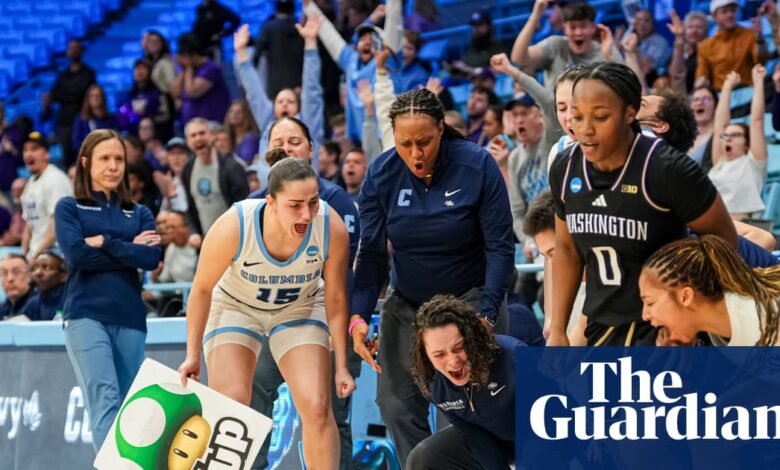
In the four seasons preceding this one, the Columbia women had a regular-season Ivy League record of 50-6, and an overall ledger of 100-27. Griffith is the winningest coach in Columbia women’s basketball history and has been the Ivy League women’s basketball coach of the year in each of past three seasons. Her teams have beaten opponents from the Big Ten, Big East and Atlantic Coast conferences and have tied for or won the regular-season Ivy League title in each of the past three seasons. They have yet to win the league’s postseason tournament but were invited to the NCAA Tournament in each of the past two seasons. Putting icing on the cake, last March, Columbia upset Washington 63-60 to score their first-ever NCAA Tournament victory and send the Huskies home from the dance.
Griffith knows how to teach fundamentals and motivate her players to get the most out of them. Coaches can spend hours expounding on their role, but Griffith says simply, “I see coaching as teaching and impacting positive change on lives. The players learn accountability, resilience, and how to do hard things together. Other than that, the game is as simple or as complicated as you want it to be.”
Recruiting is a neverending task. Griffith calls it “the hardest part of my job”.
The most talented high school seniors gravitate toward big-time basketball schools. The Ivy League doesn’t allow for revenue sharing with players. And even if it did, there wouldn’t be much revenue to share. The league does allow players to monetize their name, image and likeness, but there are no athletic scholarships. Moreover, a talented player may want to come to Columbia, only to be rejected by the admissions office.
The core of Griffith’s recruiting pitch is: “Come to Columbia. You’ll be getting a great education in the best city in the world. It will be a transformative experience for you.”
She could add, “We now play winning basketball.”
That brings us to this year’s Columbia women’s team. The Lions have struggled at times. “In the last two years, I had the best basketball player [Abbey Hsu] and best leader [Kitty Henderson] I’ve ever coached,” Griffith says. “And both of them graduated. That’s hard to replace.”
The Lions also played a challenging early-season schedule that included an 80-63 loss to nationally ranked North Carolina.
Sometimes everything has seemed to go right for Columbia, as it did in an 89-32 drubbing of Dartmouth and a 73-67 upset victory on the road against 19th-ranked Princeton. But there have been times when everything seemed to go wrong, as was the case with upset losses to Cornell and Penn.
“Those two losses showed us the maturity that we’re lacking as a team,” Griffith says. “Cornell and Penn played well. But if you’re an emotionally mature team like I think we’re becoming, you don’t lose those games. It taught us a lot.”
Columbia evened accounts with Cornell with an 80-55 road victory in Ithaca on 7 February. That gave the Lions a 6-2 Ivy League record, good for a second-place tie with Harvard, one game behind Princeton. This past weekend was pivotal, with back-to-back home games against Princeton and Penn. Princeton would be looking for revenge against the Lions on Friday night. One night later, Columbia would seek the same against Penn.
Like many sports fans, I’ve followed Geno Auriemma’s accomplishments at UConn and took note when Caitlin Clark set the basketball world ablaze. I watch a handful of NCAA women’s tournament games on television each year and am familiar with names such as Dawn Staley, Kim Mulkey and Chris Dailey. But I’d never been to a women’s college basketball game. I decided to go to the Princeton and Penn games last weekend.
Columbia’s main campus stretches from 114th to 120th Streets between Broadway and Amsterdam Avenue and looks remarkably similar to how it did a half-century ago. There’s an aura of classical elegance. Fourteen massive columns rise to the facade of Butler Library where eight names are chiseled in stone: “Homer. Herodotus. Sophocles. Plato. Aristotle. Demosthenes. Cicero. Virgil.” Low Library is equally inspiring with a facade that tells of Columbia’s founding as King’s College in 1754.
Levien Gymnasium, which opened in 1974, seats 2,700 fans for basketball. In Griffith’s first year as coach, the women averaged 627 fans per game and the men 1,625. Last season, the women averaged 1,602, reaching 2,307 for the season finale against Cornell that clinched the Ivy League regular-season title for Columbia.
Before going to the games, I talked with Dave Kindred, the octogenarian sportswriter who has won enough sports journalism awards to hang a plaque on every wall in his home. In 2010, when his sportswriting days on the national stage came to an end, Kindred went to a high school basketball game to see the daughter of friends play. Before long, he was hooked. In 2023, My Home Team: A Sportswriter’s Life and the Redemptive Power of Small-Town Girls Basketball – possibly the best book ever written about women’s basketball – was published.
“I saw a thousand men’s basketball games before I started watching the women,” Kindred told me. “And now, I actually like watching the women more. The basics are the same. The women know how to play. Their competitiveness and the desire to win are just as strong as with the men. They dive for loose balls with the same ferocity as the men. But the women play more of a team game
“The men do things that the women can’t do,” Kindred continued. “They jump higher and run faster. The men play a vertical game. The women play a horizontal game. The men play in the air. The women play on the floor. The men can create plays by themselves. The women, except for a few superstars, need help. So what happens is, the women compensate by helping each other. They make three passes to get to the same point on the floor that a man gets to on his own. In a way, the women now play like the men used to play when I was young.”
Those words rang true as I watched the Lions play on Friday and Saturday night.
Columbia’s most complete player this season has been junior guard Riley Weiss – a five-time Ivy League player of the week who also leads the league in scoring with 19.7 points per game. Susie Rafiu and Perri Page are major contributors and the only seniors on the squad. Junior Fliss Henderson is the Lions’ leading rebounder. Like their teammates, these are formidable athletes – well-conditioned, fast and strong. And they understand technical intricacies of the game that most fans don’t even know exist.
There was a sense of anticipation as tip-off for Columbia v Princeton neared on Friday. The betting spread favored Princeton by 4.5 points.
The game started poorly for Columbia. The Lions’ shots weren’t falling. Rafiu picked up two fouls in less than seven minutes. Princeton led 20-11 after the first quarter and stretched their lead to 29-18. The margin narrowed to 31-25 at the half but Columbia were lucky to be that close. The Lions had shot a dismal 10-for-28 from the field. The Princeton defense had smothered Weiss, who was 1-for-7 from the floor. Ten points, five rebounds and stellar defense from Page had kept Columbia in the game.
Then everything changed. Basketball is a game where the better team can beat the better players. Columbia began playing well as a team at both ends of the court. Weiss got hot, finishing the contest with 23 points on 7-for-9 shooting in the second half. Page had a career-high 25 points and dominated the boards in tandem with Henderson. Columbia outscored Princeton 22-10 in the third quarter. The fourth quarter brought the same. The crowd of 2,014 stood and roared its approval during the closing seconds. Final score: Columbia 70-56 Princeton.
Saturday night was more of the same. Griffith had to keep the team focused. The Princeton game was in the past. This was Penn. But the Lions started with a vengeance, playing suffocating defense and opening a 27-7 lead midway through the second quarter. Columbia were doing most things right. And Penn were doing most things wrong. The Lions’ intensity faded as the game went on. “Second half, we were not very good,” Griffith acknowledged afterward. But they were good enough for a 69-56 victory.
Columbia and Princeton (8-2) are tied for first place in the Ivy League, with Harvard and Brown a game behind at 7-3. Each team have four regular-season games to play and are all but certain to qualify for the four-team postseason tournament that will decide who gets the Ivy League’s automatic qualifying bid to the NCAA Tournament. Should the Lions fall short in the Ivy tournament, an “at large” bid to participate in the NCAA Tournament will still be possible.
Beyond that, the future looks bright. Griffith says the freshman class that will enter Columbia this fall is “the best recruiting class we’ve ever had” with blue-chip prospects coming from California, England and Australia. Equally important, $8m out of a recent $10m gift from Jonathan and Jeannie Lavine to Columbia’s basketball program has been earmarked for the women. “That,” Griffith notes, “gives us long-term financial stability for the first time.”
Griffith takes pride in the fact that, in all her years as head coach, not a single Columbia player has transferred to another Division I school. It speaks to the loyalty she inspires and the culture that she has created. She has built a good program, not just a good team. But there’s a question that has to be asked.
Griffith is an exceptionally good coach. It’s inevitable that she’ll receive lucrative offers from big-time colleges. Will there come a time when she leaves Columbia?
“I love change,” Griffith answers. “But I have a strong sense of pride in Columbia. I’ve grown up here. I’m a Columbia alumna in addition to coaching here. I love it that, every year, we have changed so much. And I haven’t accomplished everything that I want to do here. The job isn’t done yet.”
-
Thomas Hauser’s email address is thomashauserwriter@gmail.com. The audio version of his memoir – My Mother And Me – was recently released. The reading is by Hauser’s good friend, Jim Lampley. In 2019, Hauser was selected for boxing’s highest honor – induction into the International Boxing Hall of Fame.