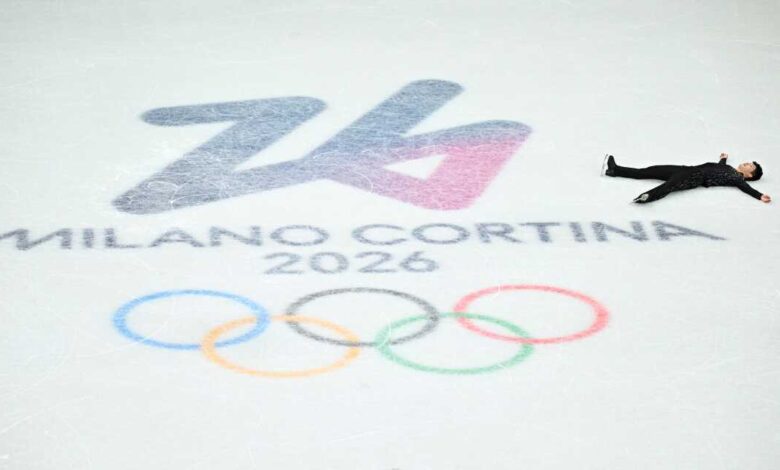

The Olympics are exhausting. Above, Taiwan’s Li Yu-Hsiang reacts after competing in the figure skating men’s singles free skating final in Milan on Feb. 13.
Gabriel Bouys/AFP via Getty Images
hide caption
toggle caption
Gabriel Bouys/AFP via Getty Images
Let us say up front that watching some of every sport at the Winter Olympics is not as challenging as watching some of every sport at the Summer Olympics. The Summer Olympics are a sprawling collection of activities, where you might see horses or swords or boats or surfboards.

The Winter Olympics still feel very rich, but they’re a bit more focused. My own brain roughly sorts them into team sports like curling and hockey, figure skating, running on snow, going down a hill on snow, sliding down an icy track, and flying through the air in much the way I might if I went skiing or snowboarding, except it’s graceful and on purpose, and you generally do not end up in the hospital.
And I found it all completely captivating.

Franjo Von Allmen of Switzerland in action during the men’s downhill on Feb. 7.
Alexis Boichard/Agence Zoom/Getty Images
hide caption
toggle caption
Alexis Boichard/Agence Zoom/Getty Images
Alpine skiing: One of my limitations as a watcher of downhill skiing is that most of the runs look similar to me unless someone crashes or unexpectedly departs the course. You could show me 10 skiers going down a mountain, and without their times showing up in green or red, I would have no idea which ones were good or which ones were bad. I would simply say, „Great job getting to the bottom very quickly.“ And yet, through the fantabulous deployment of technique, you can earn edging someone out by a tenth of a second. A tenth of a second! Or less!
The slalom events are delightful, because they progress from slalom … to giant slalom … to super-G, which is super giant slalom. There is only one way for this to go, as we all know, and that is in the direction of mega super giant slalom, or M-S-G (which makes all other skiing more appealing because it adds umami flavor). I could try not to say „whoosh, whoosh, whoosh“ out loud while watching the slalom events, but why? In 50 years, when we are all watching jetpack slalom, I will still say „whoosh, whoosh, whoosh.“
Biathlon: This is the rare sport that seems to me to be fully wicked, for the simple reason that no one should be asked to hit a tiny target after wearing themselves out. Imagine you run 10 miles and then somebody hands you a slingshot and says, „Lie on the ground and hit that 5-Hour Energy drink bottle way over there.“ That is unkind. Biathlon also has a rule where missing shots can require you to ski a „penalty loop,“ which is the most „coach gets mad and makes you run laps“ thing I have ever seen at the Olympics. I admire and sympathize with everyone involved.

Bobsled: Watching a team smoothly (usually) jump as many as four bodies into a very small vehicle — while running — is such a feat that bobsled would be enjoyable if it were only that. But like all of the sliding sports, it also suggests a willingness and an ability to skirt the line between controlled descent and mad careening. I particularly enjoyed the women’s monobob, both because Team USA athlete Elana Meyers Taylor won her first gold at her fifth Olympics and because the word „monobob“ (a one-person sled) is delicious and melodic.

Cross-country skiing: I am exhausted just from typing those words. Where I live, we are just getting rid of snow and ice on the ground that hung around for a month. For the first week or two that we existed in its presence, one of my primary goals on any given day was not to traverse it for any reason. At one point, I picked up a heavy sandbag and walked out into my own backyard, laying down a sand track in front of myself, picking my way across the ice rink and making my way to a piece of trash my dog had found somewhere so I could remove it (in case it was something he should not have, like a chicken bone or an ex-mouse; it was in fact a paper towel). By the time I got back to the house, I certainly felt like I had earned a gold medal. What I’m saying is this: I am in awe of cross-country skiers for their stamina, resilience and balance, even though in fairness, they did not have to carry sand at the Olympics.

Curling: Oh, how I love curling. That anyone can slide a 40-ish-pound rock down the ice something like 150 feet and get it to land on a spot the size of your shoe is astonishing. From time to time, a curler makes a shot that seemingly sorts through a clump of red and yellow stones and knocks out all of one color without disturbing the stones of the other color. From 50 yards away! Moreover, you get to hear the players talking. Everybody has mics on, so they chat about what shot they should try, what shot is too risky, what shot the other team will try to make based on what shot they try to make … like baseball, it is meditative, with long periods of deceptive quiet followed by bursts of excitement. Like baseball, it rules.

Figure skating: The best thing about figure skating is that it is beautiful and graceful and athletic, and the programs have become more creative (to my eye) and less staid since I was a kid. Of course, the most difficult thing about it is that a single fall — truly, a single bad moment — can prevent a skater who has worked toward a goal for 15 or even 20 years from realizing that goal, even if it’s a fluke, a one-off, a thing that never happens. NBC’s coverage this year has really focused on sending the camera practically up into the nostrils of a skater who has just had a bad moment so you can have the most visceral possible look at their pain. That does not prevent post-bad-program interviews in which they are asked to explain their pain 30 seconds after it happens, sometimes at the cost of covering people who did well.

It makes sense that U.S. coverage focused, for instance, on the many problems that befell Ilia Malinin in the men’s free skate (resulting in an 8th-place finish for a heavy gold-medal favorite), but there was also triumph for Kazakhstan’s Mikhail Shaidorov, who won the gold medal after a free skate during which the commentators were explaining that he was not really a medal contender this year, but might be in another four years. I mean, you’ve gotta love that.
Freestyle skiing: There is much to love about freestyle skiing, which crosses over with some of the things to love about snowboarding. There are aerials, there are tricks, and there is the aptly named discipline „Big Air.“ But perhaps my favorite event is moguls, where the competitors go down a course that is intentionally made up entirely of bumps, and one of the tricks is to let your knees absorb all the bumps so that your upper body barely moves at all. I think everyone who has ever so much as sprained an ankle watches moguls with astonishment. If I consistently say „whoosh“ while watching slalom, I consistently say „ow ow ow“ while watching moguls.

The U.S. women’s ice hockey team huddles prior to a match against Czechia on Feb. 5 in Milan.
Jamie Squire/Getty Images
hide caption
toggle caption
Jamie Squire/Getty Images
Ice hockey: I am not particularly invested in Olympic ice hockey, particularly the men’s, because it involves so many professional players who play each other all the time, and that’s not what I’m watching the Olympics for. But I try to catch some of the women’s tournament every time. (It’s perhaps not surprising, given the fact that trying to follow the puck has always kept me estranged from hockey, that I so dearly love curling, which has all the ice and all the precise shots, except with a „puck“ that is huge and slow.)
Luge: What an absolutely terrifying notion. Surely the most terrifying sport the Olympics could possibly come up with. Only the security offered by doubles luge, in which two people lie on top of each other, could possibly make this feel like a good idea. Lying on your back? Without being able to see where you’re going? If your kid wanted to go down the driveway like this on a flattened cardboard box, you would probably ground them.

Einar Lurås Oftebro of Norway’s Nordic combined team competes on Feb. 11.
Alex Pantling/Getty Images
hide caption
toggle caption
Alex Pantling/Getty Images
Nordic combined: This is cross-country skiing plus ski jumping. Two very efficient ways to cross snow, although one of them requires a ramp and a tolerance for risk. Here’s a question: Why isn’t this biathlon? This could be biathlon, and what is now biathlon could be the ski-n-shoot. I’m just throwing ideas out there. Innovating. (In all seriousness, read up on the status of Nordic combined and the athletes, women in particular, who stand to lose out based on International Olympic Committee decisions about the present and future.)
Short track speedskating: This is the speedskating I like the best, because I am unsophisticated and impatient. I don’t want to watch each person methodically lay down a time that other people then try to beat. I want to watch a bunch of fearless adrenaline junkies go fast around a track like it’s roller derby, except (mostly) trying not to knock each other over. I want to watch them hurl themselves across the finish line, sometimes backwards.
Skeleton: What’s this I’m hearing? Oh, never mind, this is the most terrifying sport they could have created. If you think flying down the track not being able to see where you’re going is scary, you’ll love flying down the track being able to see exactly where you’re going, because you are leading with your head. There’s been a lot of chatter this year about the way the Winter Olympics, more than the Summer Olympics, feel like they’re made up of various ways to barely not splatter yourself across the host city, and nothing says that to me like skeleton. They really only give you a helmet, and I wouldn’t do it in a helmet. I would require a helmet and a shark cage. And honestly at that point, I would just close my eyes.
Ski jumping: Ski jumping is very cool, and it’s kind of unfortunate that coverage got distracted this year by a story about … well, about the suits that the men wear, and how they’re fitted, and some other things. The amount of time that ski jumpers spend in the air is unfathomable to me, and the fact that they land on their feet instead of on an enormous inflatable cushion seems impossible, but they do it.

Germany’s Finn Hoesch competes in men’s sprint ski mountaineering on Feb. 19.
Dimitar Dilkoff/AFP via Getty Images
hide caption
toggle caption
Dimitar Dilkoff/AFP via Getty Images
Ski mountaineering: I have seen only a bit of this sport, because it’s its first year at the Olympics, and it didn’t really start until Thursday. If you’ve never watched it, here’s what it looked like when I watched it: The athlete runs up the mountain part of the way on skis with „skins“ on the bottom for traction. Then the athlete takes off the skis and runs up a set of stairs. Then they put the skis back on, run up the mountain on skis the rest of the way, take the skis off, rip the skins off the skis, put the skis back on, and ski down the mountain. The women’s gold medal was determined not by the speed of running in skis, running out of skis, or skiing, but the speed of changing the gear all those times. (This also can happen in biathlon, where sometimes you ski well and you shoot well, but you spend too much time noodling around with your gun.) It is a truly wild sport, and I loved it instantly. Who hasn’t been foiled on a busy day by the inability to get your shoes on and off quickly?
Snowboard: I love to watch snowboarders, because they are so much less likely to look devastated when something bad happens than, say, figure skaters. This is partly because they often have more than one run, and it certainly doesn’t mean that they are less competitive or work less hard. But the culture of snowboarders seems to be a little different, and from time to time you will see one absolutely wipe out, and then hop up and throw their arms over their head in a combination of „Wooo!“ and „I’m fine!“ It’s good to have fun.
Speedskating: Speedskating is the sport I admire more than love. As with long-distance running, I am brimming with admiration for the people who do it, but I struggle to be entertained as a spectator. (Other people think this about curling, I realize. Imagine that!)
But this is part of what watching the Olympics is, right? You try out lots of sports. You sample some fast ones, some more slow-paced ones, some with short races and some with long races. And you decide: This one is mine, this is the one I’m going to follow. And it’s great.
Even for those of you who do not choose curling.

Megan Oldham of Team Canada warms up prior to the women’s slopestyle final on Feb. 9.
Patrick Smith/Getty Images
hide caption
toggle caption
Patrick Smith/Getty Images
This piece also appeared in NPR’s Pop Culture Happy Hour newsletter. Sign up for the newsletter so you don’t miss the next one, plus get weekly recommendations about what’s making us happy.
Listen to Pop Culture Happy Hour on Apple Podcasts and Spotify.