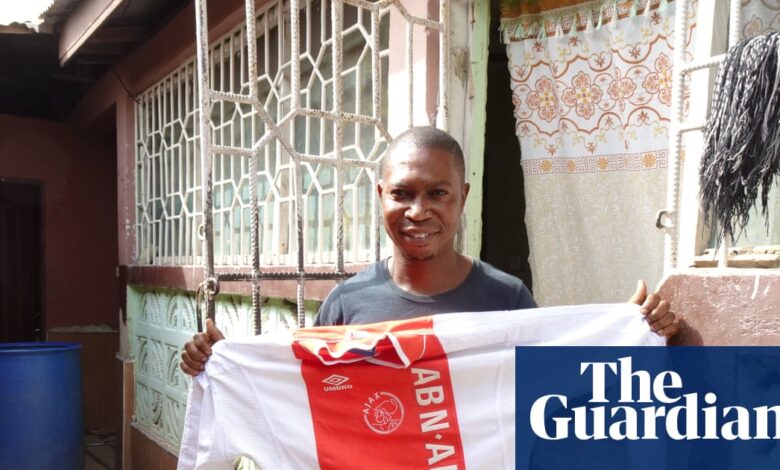
John Quansah looks at a glass display case hanging on the wall of his living room in Obuasi, Ghana. Inside are three trophies from his days as a youth player at Ajax. For years, they lay tucked away in the back of a cupboard, but two years ago, that changed. “I’m an adult now,” John says. “It’s time to look at the past differently. When I look at the trophies now, I don’t just feel pain. I am grateful too – for those beautiful years.”
Of course, he didn’t fulfil his big dream. But not everyone can say they have played for Ajax. He has every reason to be proud, to look back at that time with satisfaction. During a move, he finds the trophies again and decides to mount a display case on the wall of his new living room. Inside, he places three trophies. One for the best player at a youth tournament in Belgium. Next to that, one from another competition, and one he received for sportsmanship, also awarded in Belgium.
Together with his wife and five-year-old son, he lives in a suburb of Obuasi, Ghana’s mining stronghold. Outside, chickens and goats wander through the streets. A narrow stream winds between the houses. Banana trees stretch toward the sky. Music pours from homes with corrugated iron roofs, while women crouch out front, washing clothes in large plastic tubs.
John’s house is around 30 square meters. A white metal grille frames the doors and windows. White curtains with red flowers hang behind the bars. In the small kitchen are blue buckets, pots, pans, toothbrushes and two gas burners. Three construction helmets hang on the wall – two white, one red. The red one hangs in the middle. John works in construction and earns 80 Ghanaian cedi per day, about £5. His wife sells hairpieces and flip-flops by the roadside. Some days she doesn’t sell a single thing. With inflation rising sharply, it’s hard to make ends meet.
The living room has space for just two small blue sofas, a television and the glass display case. John can’t ignore it, but that’s also not what he wants. He doesn’t want to hide his past anymore. “Wait a second,” John says. He disappears into the bedroom, the third and final room in the house. The toilet and shower are shared with neighbouring families. After some rummaging in a cupboard, he comes back out. In his hands: a long-sleeved Ajax jersey. His Ajax jersey. “Until we moved here two years ago, I couldn’t stand to look at it. It hurt too much. But now, I’m beginning to feel proud.”
In the early 2000s, things are looking good, John says as he sits down on one of the two small blue sofas. Of course John wants to play for Ajax. His dream is to become a great football player. So when he’s invited to Amsterdam 25 years ago, he can hardly believe it. Along with two other 15-year-old Ghanaian boys, he is discovered on the pitch of Ashanti Gold in Obuasi – at that time one of the biggest clubs in Ghana. The club was founded in the 1970s by miners from the town, and in the late 1990s Ashanti Gold became part of Ajax’s broader effort to scout foreign players at younger and younger ages. Promising talents are invited to spend trial periods in Amsterdam – training, playing friendly games – so that when they turn 18, they already know the system. After similar partnerships in South Africa and Belgium, Ajax set their sights on Ghana in June 1999.
John is obsessed with football. Much to his mother’s frustration. “She wanted me to focus more on school. But I didn’t like school. I wasn’t good at it. And all I wanted was to play football with my friends.” But what if football doesn’t work out? How will he earn a living? Jobs are scarce in Ghana’s poor interior, so school is essential, his mother says. She raises John and his older brother alone; their father died of complications from diabetes when John was still a baby. Not even 40 years old. Because life is difficult, she repeats the same message again and again: education is the way out.
But John shrugs. He has just one goal: to become a professional footballer. When he hears that Ajax is organising trials, he signs up without hesitation. The scouts aren’t just there to evaluate talent. They check ages, too. Together with more than 100 other boys, John lines up shirtless in shorts along the touchline at Len Clay Stadium. With the help of a local coach, Ajax representatives move along the row, asking each boy how old he is and what his year of birth is. If a player gives a hesitant answer, looks too mature or contradicts himself, he’s out. Immediately. John passes the test. He’s short, so his height doesn’t disqualify him, and he answers confidently. His dribbling is dazzling, and John is one of only three players chosen.
About six weeks later, he leaves for Amsterdam for the first time. “I could hardly sleep in the weeks leading up to it. I was counting the days.” In bed, he imagines what it would be like in the Netherlands, to train with a top European club and perhaps one day play in a stadium for 50,000 people. His mother initially protests a bit, but then sees that her son only wants one thing and gives him her blessing. John quits school to focus entirely on football.
When the day of the trip arrives, John hugs his mother and gets on the bus, together with the two other lucky ones. It is the first time he has ever left Obuasi. During the seven-hour bus ride to the capital Accra, he stares out of the window. He feels it: the greatest adventure of his life is about to begin.
In Amsterdam, the boys are picked up by Ajax staff and taken to a host family in Soest, a small town not far from Utrecht. The sweet Ab and Riet are already waiting for them, along with their son and daughter. A Finnish youth player named Jussi Kujala is also staying there. Jussi doesn’t make it at Ajax, but eventually plays a few seasons for De Graafschap in Doetinchem. John trains daily at De Toekomst, Ajax’s youth complex. He also goes to school and learns Dutch. The cold, rainy Dutch weather takes some getting used to, and he misses his mother terribly. But the warmth of the host family helps, and on the pitch, he adjusts quickly. As a fast right winger, he impresses the people of Ajax. His two travel companions are soon sent back to Ghana, but not John. He is allowed to stay.
John is doing well. Both on and off the field. He enjoys the Netherlands, visits to the zoo, an ice hockey match and a climbing park. On the field, he excels during a youth tournament in Belgium. Ajax finish third but John is named the best player of the tournament. He proudly holds up the trophy that is presented to him. He plays alongside future stars such as Wesley Sneijder, Nigel de Jong, Maarten Stekelenburg and Daniël de Ridder. In Soest, he feels more and more at home. Ab, Riet and their children give him lots of love and attention, and real Dutch food. Although John likes potatoes, he squirts a mountain of ketchup on everything. “That’s why they started calling me Johnny Ketchup!” he laughs.
He makes the journey from Obuasi to Amsterdam four times. Every time he’s back home, he counts the days until he can return. Usually, he stays home with his mother and brother for about six weeks before getting back on the bus. During those periods, he joins a local club and trains with them to stay fit, so he can return to Ajax in good shape.
And then it goes wrong. He and his teammates line up on the halfway line. The coach stands on the edge of the penalty area. Each player passes him the ball, sprints after it, and finishes the return pass on goal. The first few runs go smoothly. Then, during his fourth sprint, John feels something tear in his right thigh. He limps off. “I went to the hospital. They did a scan, but nothing showed.” He undergoes physiotherapy. He rests. He tries to train again. The pain returns. Ajax tells him: recover first. Once you’re fit again, we’ll come to see you in Ghana.
John clings to that promise. He tells himself: this is just a temporary setback. Will he surely get fit again? His big dream can’t end like this? But the pain won’t go away. No matter what he does, rest, treatment, training, it always comes back. Ajax don’t return. Slowly, his dream fades. “It hurt so much,” he says, eyes low. “I didn’t understand. Why me? I wanted it so badly. But it just wouldn’t work anymore.” He tries to keep playing at several clubs in Ghana. But his body keeps breaking down. In his early 20s, he gives up football altogether. He shuts himself inside. When friends or family come to check on him, he doesn’t answer. “God will help you,” they tell him. But he no longer believes in that. He waits until the knocking stops. Then he sits in silence.
After a few weeks, he emerges. He tries to move forward. He opens a small food stall, frying rice for hours. But no one buys it. He relocates. Still nothing. Eventually, friends help him get a job in construction. He works six days a week, building houses, schools, hospitals. Long hours in the blazing sun. Barely enough money to eat. But it’s something. He marries. He becomes a father. He knows he needs to earn money to get food on the table each day.
Then comes a new kind of pain. In 2019, his first child suddenly falls ill and dies. Just six months old. “We went to a doctor,” John says, “but he didn’t know what was wrong. Before we really knew it, our son was dead …” The grief is almost unbearable for the young parents. They have another child. And a third, a boy like the previous two. Once again, something happens that no parent wants to experience. The younger boy dies, just four months old. Seriously ill again and a doctor who doesn’t know what to do. Once again, unbelievable suffering for John and his wife.
For years, John avoids football as much as he can. Whenever he sees a match and his former teammates Sneijder or De Jong, he quickly changes the channel. His Ajax shirt and trophies remain hidden deep in a closet.
Until two years ago. He decides to face his past, and he mounts the glass display case in the living room. The more often he walks past the trophies, the more pride he feels. His time at Ajax no longer brings only pain. “I once trained with Ajax’s first team,” he says. “I crossed the ball to Zlatan Ibrahimović, and he scored. He ran over to me and lifted me in the air, like, above his head! He was so happy with the pass. Beautiful, huh?”
He disappears into the bedroom again. A few minutes later, he returns holding a thick stack of photos. “Given to me by my host parents,” he says, beaming. He sits down and begins flipping through them. Each one brings a story. “Here I was a ball boy in the Arena,” he says. In the photo, he’s sitting with a ball in his lap, a wide smile on his face. “I had to run a lot that day – but it was great.” Another photo shows a smiling John in the stands of the Arena. “The stadium was so beautiful. The cars could park underneath!”
He can still remember the entire adventure minute by minute. “It started with the day my name was called in Ghana, and I would go to Ajax. I was so happy. And again, when I was finally allowed to stay in Amsterdam. Of all the foreign players, two players were chosen. First the name of a Mexican was called and then mine! It was wonderful, the best period of my life.”
John continues browsing through the pages. He shows photos of a tournament in Italy that he flew to, and one of Cristian Chivu warming up. “We often watched the first team. My dream was to join them – and then move on to Manchester United.” There’s another shot: John behind a computer. “That’s me learning Dutch. Ik ben John en ik woon in Soest.” I’m John and I live in Soest, he tries in Dutch.
He had an injury before, but kept it to himself. “During a training session in Ghana, I started having problems with my right groin. As a result, I could no longer shoot properly with my right foot, even though that was my favourite leg. That’s why I shot everything with my left foot back at Ajax. The trainers wondered where the real John Quansah had gone. I didn’t say anything about my injury, because I was afraid that I wouldn’t be selected anymore. Fortunately, I recovered and was able to show what I could do again.”
He believes he might have earned a contract. “There weren’t many good right-wingers back then. Daniël de Ridder sat on the bench behind me. After my injury, he started playing. He got the deal. I was happy for him. But later, when they stopped playing, I was relieved. At least I didn’t have to see them anymore.”
John would love to visit the Netherlands again. He once tried to get a visa to return to the Netherlands. The man who promised to help him disappeared with the money. “I’d still love to go back,” he says. “To visit my host family. Maybe see Sneijder or De Jong again. I wonder if they even remember me.”
These days, John is doing OK. He has accepted that his football dream is over. But the grief over his children remains. Then, last year, his mother dies, suddenly, of a heart attack. “Everything always goes wrong in my life,” he says. “I don’t know why. I just have bad luck, I think.”
Still, he wouldn’t have missed his adventure at Ajax for anything. Maybe he should have listened to his mother and not quit school when he started playing for Ajax. He might not have had as many financial worries as he does now. John doesn’t blame Ajax for the fact that he now lives in poverty and his big dream didn’t come true. “I didn’t have a contract with the club, so I wasn’t their responsibility. My hope was to recover, but yeah … ”
One Dutch word has stuck with him: the word for thigh. “Bovenbeen,” he says while showing a photo of him with a large bag of ice on his right leg. In the meantime, he reads the Bible.
“I was praying for my injury to heal. For a long time, I asked God why all this had to happen to me, both as a footballer and afterwards. I always thought I was born to be a footballer. I lost my trust in God for years, but I gradually regained it. It also gives me stability and strength, even when everything seems to be against me. I think God has a different life purpose in mind for me. He wanted me to play football as a hobby, not to earn money. What my purpose in life is, I still don’t really know. It remains a struggle. The most important thing is that I’m still alive. Hopefully, I’ll find my purpose in life one day.”