College basketball’s depth at top best in decade-plus; Inside Dybanta’s December

Welcome back to the Court Report, Matt Norlander’s in-season college basketball notebook feature that provides insider information and a deeper look at the trends and things to know around the sport. Consider this edition a bonus present under your proverbial college hoops tree, especially amid a light week for games. Merry Christmas!
The further we get into this spectacular season, the more I’m convinced the quality at the top of men’s college basketball is deeper and more impressive than any season in the past decade, if not more.
It’s easy to get that impression when you see Michigan routinely dismantling teams by 30, if not 40 points; or Iowa State handing a robust Purdue team the program’s worst home loss ever; or Arizona becoming the only squad in history to win five of its first nine games against ranked competition; or Duke and BYU combining to go 23-2 behind the phenoms who might be the top two picks off the board in the 2026 NBA Draft.
I’ll keep going.
There’s Gonzaga’s return to supremacy with its 12-1 run out of the gate, an introduction matched by UConn’s restoration to elite-level play with its own 12-1 start. North Carolina is also 12-1 heading into 2026, putting on its best nonconference showing since the 2008-09 team won the national title — and doing so with Caleb Wilson, its best freshman since Cole Anthony.
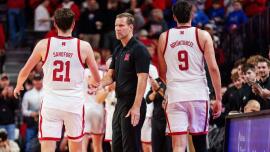
Houston? Very much good enough to win it all after falling one shot short in April. Speaking of teams making recent Final Fours, Purdue getting back for the second time in three years wouldn’t shock anyone who’s paying attention. Also in the Big Ten: Michigan State sits at 11-1 and has one of the three best point guards in college basketball, Jeremy Fears. Vanderbilt and Nebraska — Vanderbilt! And Nebraska! — are undefeated and look headed toward special campaigns as well.
Norlander’s Court Report: Fred Hoiberg’s Huskers the feel-good story of season; Boozer-Yax NPOY race heats up
Matt Norlander
There’s been a conspicuous lack of upsets, but the exchange for that is a run on high-end teams that might give us the most competitive season in recent history. As Christmas arrives, there are six undefeated teams and 20 more one-loss teams still on the books.
In addition to the attractiveness of so much winning from so many interesting teams over the past seven weeks, there’s data to back up the idea that we’re in the midst of an unusually strong season at the top of college basketball.
As of Christmas, seven teams boast an adjusted efficiency margin of 30.00 or better at KenPom.com (with two more, Vanderbilt and Illinois, clearing the 29.00 threshold). And while intra-conference play promises to shave off some of the sweetness on some of these teams over the next 10 weeks, there’s still a realistic chance that 2025-26 will yield the strongest group of national title contenders since at least 2014-15. That’s when Kentucky made it to the Final Four undefeated and the Wisconsin team that upset Kentucky fell to Duke in the NCAA title game. Those three teams in addition to 33-3 Villanova, 34-4 Arizona and 30-4 Virginia all wound up above +30.00 in adjusted efficiency margin. Kentucky’s undefeated push into April overshadowed the fact that all six were viable national title contenders.
This season looks primed to produce even more.
For reference, here’s how many teams finished above +30.00 in adjusted efficiency margin at KenPom since ’14-15.
- 2014-15: 6
- 2015-16: 1
- 2016-17: 1
- 2017-18: 1
- 2018-19: 5
- 2019-20: 1
- 2020-21: 2
- 2021-22: 1
- 2022-23: 0
- 2023-24: 3
- 2024-25: 6
- 2025-26: 7 as of Christmas; TBD by April
Last season was the mighty SEC’s doing as much as anything, and you can make the case that this year is merely competing with what we saw a season ago in terms of might at the top … until you realize this season is outpacing 2024-25’s impressive output.
On Christmas Day in 2024, the top 10 teams in the AP poll weren’t winning as much or by more on average than this season’s cream of the crop. Right now, the collective record for the AP’s top 10 teams — Arizona, Michigan, Iowa State, UConn, Purdue, Duke, Gonzaga, Houston, Michigan State and BYU — is 113-7. A year ago at this time the AP’s top 10 were 105-13, a win percentage difference of .53 points. And a year ago on Christmas there were four teams at +30.00 in efficiency margin, not seven, and only five at +29.00 or better instead of the nine we’ve got as of today.
Going all the way back to the start of this century, here’s how the top 10 teams in the AP poll aggregated in wins and losses after seven full weeks/at the start of Week 8 in each of their respective seasons. This year has provided the fourth-most wins to this point in the calendar by the top 10 AP teams since 2000-01.
CBS Sports research
Losses are sure to come in steady doses for the top teams, but every indication to this point is that we can and will have more than just two or three „great“ groups. A common and lazy lament in many recent seasons was to suggest college basketball lacked any great teams; now we’ve seem to have been gifted a bevy of them.
I have more good news: Beyond the strength at the top, college basketball also has a chance to have its best offensive season ever. The sport’s 365 teams are combining to average 78 points per game, a number that will naturally drop over the next three months. Conference play leads to fewer possessions and tighter whistles, which will bring down scoring. This happen every season. Still, the scoring record is in sight, as is efficiency. Teams are pacing to score more points per possession this season than ever before.
It’s been a dream start so far. I think — I hope! — the patterns persist in the second half of the season.
As we ready for league play, I think the list of schools that can win a national championship — teams truly capable of winning six games in the Big Dance, a massive ask — is validated at 12, an abnormally high number for this time of year. That figure could whittle by four or five come March, and it easily could see three or four candidates not on my list now vault into the discussion before long. But heading into 2026, my dozen-deep ranking of title contenders reads: Michigan, Arizona, Iowa State, UConn, Purdue, Duke, Houston, Gonzaga, Michigan State, Illinois, BYU and North Carolina.
Those 12 are a combined 132-11. A remarkable group.
You’ll notice there’s not an SEC team in there. At least not yet. I’m just as surprised as you are. So let’s talk about that next.
After epic ’24-25, the SEC has taken big step back
Getty Images
The SEC’s collective 2024-25 season was so impressive, it almost definitely cannot be matched in the decades to come. The league sent 14 of its 16 teams to the NCAA Tournament, in addition to having two No. 1 seeds; it put seven teams in the Sweet 16; saw its two 1-seeds (Auburn, Florida) make the Final Four; and Florida won the national championship.
That kind of run is almost impossible to duplicate. And the grandiosity of it all is what’s making this season’s SEC look so down in comparison.
Missouri’s humiliating no-show loss Monday night to Illinois (91-48, the largest margin in the history of that rivalry) in the annual Braggin’ Rights game was the league’s 50th nonconference defeat through the first 49 days of the season. Last season, the SEC lost 23 non-con games total — including all postseason play — leading to a staggering 185-23 record and an .889 win percentage. We will never see a league-wide success rate like that again.
This season, the SEC has a .742 win percentage (144-50 overall) and its impotency against ranked teams and fellow high-major schools is worrying evidence against the league’s chances of getting more than eight or nine into the field come March.
A year ago, the SEC finished with 73 wins against high-major opponents. This year, the SEC’s record vs. the other four Power Five leagues sits at 35-47. When you filter through for games vs. AP Top 25 teams at the times of those games, the SEC is in fifth in win percentage. Here’s how the high-majors stack up in ranked-on-ranked outcomes:
- Big 12: 13-13 (.500)
- ACC: 10-19 (.345)
- Big Ten: 13-26 (.333)
- Big East: 5-13 (.278)
- SEC: 9-26 (.257)
In Quad 1 games, the SEC is an ugly 15-36, even falling behind the ACC’s 16-31 mark through Christmas week. Undefeated Vanderbilt is the only team above .500 against Q1 competition (3-0). And as for 12-0 Vandy, it has to be rated as the best SEC squad so far. But the Commodores haven’t been given top-10 respect yet because they’re yet to defeat a top-30 team. At KenPom, their non-con SOS is 86th. Far from awful, but also far from the high end of toughest schedules in the sport.
The irony of the SEC clearly going through league-wide regression is KenPom nevertheless still rating the league No. 1. Here’s why: Predictive models have preseason biases still having some (but not that much) influence seven weeks into the season. We call those „priors,“ and in a month, they’ll be phased out. When you filter the results purely based on win expectancy at Torvik, the SEC comes in at No. 3, slightly ahead of the ACC, thanks to not having any outright terrible teams.
The biggest knock on the league right now is, unlike the other four power conferences, I don’t know who is a true national title contender at this stage. A year ago, you could’ve made a case for five or six. Now … pick one? Vanderbilt, Florida, Arkansas, Alabama, Kentucky — would you take any of them right now to win at least four games in the NCAA Tournament, let alone six? I’m fascinated to see how this league plays out over the next nine weeks.
I do think at least one SEC team emerges as a legitimate national title contender by the end of January.
Dybantsa’s dynamite December
A week ago, right here at the Court Report, I laid out the compelling case Michigan’s Yaxel Lendeborg was building to compete with Duke’s Cam Boozer for national player of the year. Well, BYU stud freshman AJ Dybantsa is now also officially in the mix after an outstanding December that ended in exclamation-point fashion Monday night (BYU’s next game is Jan. 3 at Kansas State). Dybantsa became the first freshman this century to post a triple double with at least 30 points after he finished with 33 points, 10 rebounds, 10 assists and a pair of steals against lowly Eastern Washington, which 1-11 vs. D-I teams.
Even despite the awful competition, Dybantsa’s performance was fitting after he vaulted himself to non-negotiable First Team All-American status over the past six games. BYU general manager Justin Young tweeted Dybantsa’s December stats, which are the best of any player in the sport this month. Dybantsa’s averages in the past six games: 27.8 points, 8.0 rebounds, 5.7 assists, 2.3 steals, 65.9 FG%, 78.0 FT%, 2.5 turnovers, 29.4 3-pt% and just one foul in 193 minutes (!!) on the floor.
According to Opta Stats, Dybantsa is „the only Division I or NBA player in the last 30 seasons to have a calendar month“ with a minimum of five games played to average at least 25.0 points, 5.0 rebounds and shooting 65.0% or better from the field, all while not losing a game.
Getty Images
His talent and potential were obvious more than two years ago, when he was a rising junior who led the EYBL in scoring. He is delivering — exceeding, actually — on the hype. I caught Dybantsa in person earlier this month after BYU set a program record by overcoming a 22-point halftime deficit to beat Clemson at MSG. That was his official coming-out party for college basketball.
Now he’s positioning himself to jockey with Boozer, Lendeborg and anyone else (Joshua Jefferson, Caleb Wilson, Braden Smith, JT Toppin) that wants to join the party for NPOY. The one stat that’s not yet getting enough attention, but will if it remains true by mid-January, is Boozer (23.3 ppg) and Dybantsa (23.1) are now 1-2 in scoring. Yes, nationally. That’s a great development for the marketability of college basketball, especially since both players are vying for No. 1 overall pick status on teams capable of winning the national title.
I can’t get enough of this season and the megawatt star power it’s providing.
Norlander’s news + nuggets
• Wrote above on Dybantsa, but another player who had a huge December for a national title contender was Gonzaga’s Braden Huff. In five games, including three vs. power-conference teams, he averaged 24.4 points and 5.4 rebounds on absurd shooting splits: 53-of-74 (71.6%). He dropped a career-high 37 against Campbell on Dec. 17. If Huff is going to move into 15-plus points every night no matter what, then he and Graham Ike will be the best big man duo in college hoops.
• Best non-Gonzaga team outside the power-conference structure is Utah State. The Aggies are 10-1 and fall between 18th and 31 in every NCAA teamsheet metric. The 100-58 bludgeoning of a solid Colorado State team was a signal that this group is good enough to push for a legitimate seed (the 4-6 range) in March.
• Another mid-major to watch for that’s quietly getting it done is Tulsa. Eric Konkol’s group finished non-con at 12-1, its lone loss by one point at Kansas State. This is the best team in the American, and a big year is overdue; Tulsa hasn’t won an NCAA Tournament game since 2003.
• Did you know: Not only are Iowa State, Vanderbilt and Nebraska flawless in men’s hoops so far, but they’re the only three schools with undefeated records in both men’s and women’s hoops? The four programs are a combined 73-0. I do wonder if this is the first time we’ve ever had three schools in men’s and women’s hoops all make it to Christmas without losing a game.
• A tragic story over the weekend: Austin Peay canceled its game against UMKC after the team bus driver died during pre-game meal. The Govs will now go 20 days between games against a Division I opponent, the longest gap of the season — and the longest since the 2020-21 COVID-impacted season.
• Bill Self says out loud what most presumed was the case: Darryn Peterson’s family is dictating when he’ll return again. I know KU fans are growing tired of the waiting game, but my guess is he plays for the Jayhawks in their next game (Jan. 3 Big 12 opener at UCF).
• On Monday, the Kansas City Chiefs announced approved plans for their new covered football stadium, with the debut set for 2031. I hate how the NFL is trying to make open-air stadiums outdated concepts. There is a college basketball angle to this, though: I can almost guarantee you that we’ll have a Final Four at this stadium no later than 2035.
• Speaking of new sports arenas, North Carolina is still not sure where its basketball teams will play in the 2030s and beyond. There is a debate over whether to refurbish the Dean Dome or build a shiny new arena that would be off-campus. More than 100 former players have signed a letter that, among other things, states, „We further wish to honor Dean Smith’s request that our cherished basketball brand and legacy always remain on campus.“
• I grew up reading Andy Katz’s work at ESPN.com and I love that he’s tapping back into that spirit more and more by writing for Seth Davis’ HoopsHQ site. Here’s his latest, on Indiana State coach Matthew Graves‘ return to coaching after having triple bypass heart surgery in October.
• I was on hand in Jersey on Saturday to see Houston humble Arkansas, and my biggest regret on this Christmas Eve is not knowing only a few days ago that the commercial below existed. A friend texted me this on Tuesday; I only wish that I could have asked Kelvin Sampson and John Calipari about it. The two have coached more than 2,200 games, but only twice against each other. Yet, in 1995, they were highlighted in a commercial for Degree deodorant. I need this commercial recreated in 2026 — with Sampson and Calipari, for sure, but let’s also toss in Dan Hurley, Scott Drew and Sean Miller.