The college football transfer portal will officially open Jan. 2 and with it should come a flurry of activity, big-money deals and roster transformations.
There is more pressure than ever this time around with the spring portal period disbanded in favor of a sole winter period that runs from Jan. 2 through Jan. 16. It’s why this year’s winter portal could resemble what we see with NFL free agency with many of the best options coming off the board quickly for big money deals.
„People are going to spend out of the gate — like immediately — your top guys, your best guys, are going to go quick,“ said a Big Ten general manager. „Then it’s the rest of them that are asking for money, but at some point they’re going to come down a little bit because the money has already been spent.“
There was a belief a year ago that with the passing of the House settlement and introduction of the College Sports Commission as an enforcement arm that last year may have been the Golden Age for big paydays. With a $20.5 million revenue share cap and a promise for stricter enforcement of NIL deals, the idea was that prices would come down this cycle as teams could no longer double dip between unlimited collective money and the rev share. For a variety of reasons, however, that hasn’t proven to be the case.
In some cases, even, prices have doubled.
CoPilot
„I feel like the average starter this cycle, the sort of line you have to hit, is $600,000,“ said one SEC general manager. „I feel like last year starters’ in our conference were $300,000. Now it feels like starters are more like $600,000.“
What does that look like for the entire market? CBS Sports talked to dozens of sources from agents to general managers to collective leaders to put together value ranges for each position ahead of this window’s official opening.
Quarterback
High End: > $3.5 million
Average: $1.5 million to $2.5 million
Low End: $750,000 to $1 million
Just like in the NFL where the top quarterbacks account for around 20% of a team’s cap, the best portal quarterbacks this cycle are expected to command a hefty chunk of the pie.
Top-ranked arms like Brendan Sorsby (from Cincinnati), Josh Hoover (from TCU) and Sam Leavitt (from Arizona State) are expected to reach — and possibly pass — the $3.5 million mark.
It’s well-documented last cycle’s double dip (teams spending freely before rev-share caps were put into place over the summer) allowed teams to go gangbusters in transfer portal spending, including at QB where Duke made the little-known Darian Mensah famous for a $4 million annual salary. General managers thought there would be a downturn in spending at the position this cycle because of rev-share caps, but that sentiment has changed in recent weeks.
Getty Images
Schools are figuring out creative ways to exceed the rev-share cap, usually through marketing deals the school can find for their high-profile QB1.
„Six weeks I would have said no way,“ an ACC GM said. „In the last six weeks people have figured out ways to construct a contract. You can put 15 deals together to get to $4 million.“
What 20% of a team’s cap looks like depends on the school. Some Power Four programs will only be at the full revenue sharing max, around $14-18 million for each Power Four football programs. Other big spenders will be at $25 million-plus due to the outside name, image and likeness deals the program manages to generate.
As for whether it makes sense to pay a quarterback that much, it’s a matter of debate for the general managers we spoke with.
„Even if you’re at $25 million, are you really going to put 20 percent of your resources into one player?“ a Big Ten GM said. „You better hope he’s good. You better hope he’s Fernando Mendoza or Diego Pavia – he has to be or that’s a bad investment.“
Beyond the upper end of the market, the number required for a quality starter in the portal continues to creep up. Last year, quality-starting QBs could be found in the upper 600s and low million-dollar range. Now the same level of player costs $1.5 to $2.5 million.
Even high-upside backups who haven’t started are making that sort of ask.
„I don’t know in the portal if you’re going to get a guy experienced and proven (for) less than $2 million,“ a SEC GM said.
As for the low end of the market, there are some Power Four teams who could choose to go the discount route for a starter, be it a player jumping up from the FCS or Group of Five ranks — there are starters who’ve played a lot of snaps who can be found at that price — or betting on a player who’s shown flashes in short bursts on the Power Four level.
Running back
High End: > $1 million
Average: $400,000 to $700,000
Low End: $250,000
Similar to the NFL, at the running back spot you’ll see some college teams really prioritize it and others shy away from spending big money. There are multiple running backs this cycle who could command seven figures if they enter the portal such as Louisville’s Isaac Brown and Florida’s Jaden Baugh. The idea of a $1-million plus running back prompted strong reactions.
„If you’re spending a million dollars on a running back, you need a new GM,“ said one agent.
Said a Big Ten general manager: „The running back numbers have been absolutely stupid. They don’t make any sense.“
Still, there are those willing to invest major resources in a top running back just like the Philadelphia Eagles did in plucking Saquon Barkley away from the New York Giants or the Atlanta Falcons drafting Bijan Robinson 8th overall in the 2023 NFL Draft.
„I’m a bigger fan of running backs than the whole trend 10-15 years ago,“ said an ACC general manager. „‘Oh don’t ever draft a running back in the first round’. Well, look at all the best ones that ever played. They were all drafted in the first round.“
Once you get past the top-end running backs, most agree that you can get a good back in the $300,000-$500,000 range.
Wide receiver
High End: $1 million to $2 million
Average: $500,000 to $800,000
Low End: $300,000 to $500,000
If you want a top receiver out of the transfer portal, be prepared to spend big. Auburn’s Cam Coleman could be in the $2 million range, predicted one Big Ten general manager. Coleman is ranked as the No. 1 overall transfer in Cooper Petagna’s 247Sports transfer portal rankings.
Auburn star WR Cam Coleman to enter transfer portal: 7 potential destinations for No. 1 player in 2026 cycle
Cody Nagel
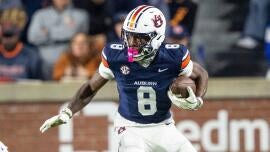
With receivers, it can depend on whether the player is viewed as a true No. 1 receiver or more of a No. 2. If you’re a true No. 1 with legitimate NFL talent, you’ll command $1 million and upward, especially the big-bodied outside plays. A Big Ten general manager, throwing out a hypothetical, said Ohio State’s Jeremiah Smith could command up to $4 million for one year of his services should he transfer. Smith is a cut above the rest of the sport, though. The hypothetical gap between him and Coleman could be $2 million — though a bidding war could also push Coleman’s number above $2 million — while the gap between Coleman can be hundreds of thousands of dollars.
As one Big 12 general manager explained: „$1 million for elite receivers, $1.5 million to $2 million for freak receivers and $400,000-$750,000 for everyone else.“
A No. 2 starting receiver could be more in the $300,000-$600,000 range. What determines the price range for those? Some of it is based on production, some of it is based on traits and some of it is simply physical attributes.
„Bigger, taller WRs, even without production, can be in that $600,000-$700,000 range,“ said an agent. „Smaller guys/third guy is $200,000-$300,000. Decent guy is $400,000-$600,000 at No. 2. Tall guys get an extra $100,000.“
In last year’s cycle, there were multiple receivers who were in the seven-figure range including Auburn’s Eric Singleton and Texas A&M’s KC Concepcion. Multiple receivers will hit that range again.
Tight end
High End: $600,000 to $800,000
Average: $300,000 to $500,000
Low End: $200,000 to $300,000
Tight end is an eye-of-the-beholder position. Some schools don’t use them much in their offense. Others require two on the field at a time. The best ones can be game changers at receiver like Tanner Koziol was for Houston this year (727 yards, 6 TDs) for a 10-win team. Interestingly, Koziol transferred to Wisconsin first, didn’t mesh and reentered the portal in the spring to emerge as a difference maker for the Cougars.
That’s why the range for tight ends is so varied.
Value is there to be found on the lower range — with at least one all-conference player this year making $200,000 this year — but mostly it’s the block-first tight ends who fit in the lower range. Most starters will be between $300,000 to 500,000 while the elite players of the cycle, like Iowa State’s Benjamin Brahmer and Tulsa’s Brody Foley, will sit between $600,000-800,000.
Getty Images
Offensive Tackle
High End: > $1 million
Average: $500,000 to $1 million
Low End: $300,000 to $500,000
Outside of quarterbacks, offensive tackle is the position that traditionally commanded the highest average premium. Even some non-proven tackles last cycle — think 300 or fewer snaps coming from a high-end Power Four program — commanded well into the seven-figure range last year.
That seems to have shifted, or at least plateaued, this cycle.
„That’s the one position that oddly feels like it’s the same market as last year,“ the SEC GM said.
As one agent with several high-level tackles — those located in the top 15 of the 247Sports rankings — put it: „Last year it seemed like if you were pretty good you could get a million. This year it seems like teams are shying away from a million. I’ve seen a lot of $700,000 to $900,000 offers for the tackles. The minute you ask for a million they clam up.“
Regardless, elite tackles will still command a million-plus. There just aren’t that many of them with those like Auburn’s Xavier Chaplin and LSU’s Carius Curne fronting the market as currently constructed — and a few big names are floating out there still as hot rumors.
Getty Images
Teams still have to pay up even for the solid starters. The average in the Power Four for that level of player will still sit between $500,000 and a million. Some teams will try to find value between $300,000 to $500,000 at tackle, but those players will either be FCS players jumping up or unproven Power Four players teams are taking a chance on.
Interior Offensive Line
High End: $600,000 to $800,000
Average: $300,000 to $500,000
Low End: $200,000 to $300,000
Opinions on guard can vary depending on a team’s priorities. Seeing them as critical interior anchors and a huge piece of the run game, some high-profile programs are willing to shell out up to $800,000 for an elite guard. Other schools, even the high-profile ones, consider them the most replaceable pieces on offense and allot around $400,000 on the high end.
Thus, the salary range can be extreme.
„A large-bodied guard could warrant $700-800K plus for a guy who could be drafted,“ said one agent who represents a blue-chip guard. The agent noted there would only be a handful of those types this cycle.
Center is a more specialized position generally than guard, so the better ones tend to be a bit more expensive. A good center with experience will be in the $500,000 range, a little higher than the average on the inside.
EDGE
High End: $1 million to $1.7 million
Average: $600,000 to $1 million
Low End: $300,000 to $500,000
After quarterback and offensive tackle, edge-rusher is the premium position where you’ll see considerable resources dedicated for many programs. If you have a game-wrecker at this position, it can open so much for you defensively and it’s why so many programs want a great one.
With high demand comes hefty prices. If a player like South Carolina’s Dylan Stewart, who recently re-upped with the Gamecocks, had instead hit the portal, he would have garnered in the $2 million range, according to a Big Ten personnel executive. If you want anyone even in the neighborhood of Stewart’s caliber, you’ll be spending seven figures this cycle. One general manager known for shopping in the expensive portal aisles said „the really good ones are between $1-$1.5 million.“
Penn State edge-rusher Chazz Coleman is the top-rated edge transfer, according to 247Sports, and No. 2 overall transfer.
Getty Images
Even just an average starting edge-rusher can command in the $700,000 range, according to a different Big Ten general manager.
„I don’t know if it’s desperation or scarcity,“ the GM said, „but guys without a whole lot of production or proven impact are commanding eye-brow raising money.“
Defensive tackle
High End: $800,000 to > $1.5 million
Average: $500,000 to $700,000
Low End: $250,000 to $500,000
The scarcity of talented defensive tackles has made this a position of high value if you’re going shopping out of the transfer portal. The gem of this year’s class is Wake Forest’s Mateen Igirogba (No. 5 in 247Sports’ rankings) who could command in that range of $1.5 million or a little more. USC transfer Devin Thompkins, No. 11 in the rankings, is another expected to be in the seven-figure range.
For a top interior defensive linemen, according to a Big Ten general manager, „to get you in the conversation it has to be at least $800,000.“ An SEC GM summed it up well, „Decent DT for $400,000-$500,000, really good ones $700,000-plus. Great ones $1 million-plus.“
Linebacker
High end: > $700,000
Average: $250,000 to $500,000
Low end: $150,000 to $250,000
The general consensus is this is the cheapest starting position outside of the specialists. Multiple people we talked to believed you could get a good starter around $300,000. If you wanted an all-conference type, it’d be in the $600,000 range. While the linebacker position isn’t where programs like to spend up, Jacob Rodriguez, who finished fifth in Heisman Trophy voting, proved this year at Texas Tech just how potent having a top linebacker can be.
‘It’s like euphoria’: How Texas Tech All-American LB Jacob Rodriguez mastered the art of the punch-out fumble
Chris Hummer

Cornerback
High end: $800,000 to > $1 million
Average: $400,000 to $700,000
Low end: $150,000 to $350,000
In part because programs need so many cornerbacks, this position has one of the widest ranges in salary, according to one agent who represents multiple top options. Some programs really value the position while others prefer quantity over well-paid quality.
Elite cornerbacks, especially in the Big Ten and SEC, can command $1 million and up. Another agent, who represents cornerbacks, says SEC and Big Ten schools will pay $700,000 to $800,000 for those 6-foot-1, 195-pound cornerback types that Nick Saban loved. Meanwhile ACC and Big 12 programs, excluding Texas Tech, might be more willing to accept a 5-foot-10 fast DB, and spend only $400,000.
A viable starting cornerback is usually going to cost you $300,000 and up. If you want more of a higher end option, that number is more in the $400,000-$600,000 range. But a Power Four nickel back could be more in the $150,000 neighborhood.
„That’s a position I feel you can get a good player for a reasonable number,“ said the SEC GM. „It’s hard to get a proven player for a reasonable number. There are good players out there for less than $400,000.“
Safety
High end: $700,000 to $1 million
Average: $350,000 to $500,000
Low end: $200,000 to $350,000
Once again similar to how NFL teams see the position in the draft, there are a few programs that really value this position but the majority are going to see an opportunity to invest elsewhere. One GM even said it wasn’t an impact position. For those that really value it and want their version of a Caleb Downs-type, as if they grow on trees, that could cost up to $1 million.
Getty Images
But, by and large, there is value to be found in the $350,000-$500,000 range. One agent even said that multiple schools told them that their budget was $350,000 for a starting safety.
„It’s just a position where there’s a lot of them,“ the agent said. „If you’re not elite they fall into a different bucket.“
Specialists
General range: $50,000 to $200,000
Specialists make money, too! It’s not often discussed in portal season, but there’s a healthy market for specialists, especially the really good ones. Solid starters will be in the $50,000 to $100,000 range. But the best kickers and punters, especially in the Big Ten and SEC, can push between $100,000 and $200,000.