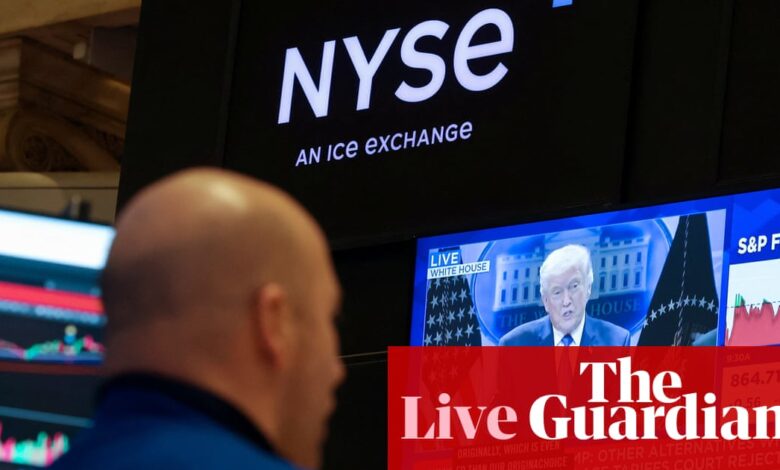
Introduction: Dollar and stocks decline after US Supreme Court hits Trump’s tariffs
Good morning, and welcome to our rolling coverage of business, the financial markets and the world economy.
We’re in a new phase of trade war uncertainty, after the supreme court blocked Donald Trump’s sweeping global tariffs last Friday.
With the president hitting back over the weekend, announcing a new temporary global tariff of 10%, then 15%, its clear that the White House is persisting with its policy of using trade levies to gain leverage over other countries.
So, as ING economists warn:
Announcements since the Supreme Court’s ruling strongly confirm that Trump has no intention of removing his “most beautiful word” from the English dictionary.
Uncertainty is back, and given the latest muscle-flexing by European leaders, the risk of escalation is now higher than it was a year ago.
The market reaction has been to sell the US dollar – it has fallen by 0.4% against a basket of other currencies today, adding to losses on Friday after the supreme court declared tariffs imposed under the International Emergency Economic Powers Act to be illegal.
US stock market futures are lower too, indicating we’ll see losses on Wall Street, while bitcoin has also weakened.
Last night, US Trade Representative Jamieson Greer insisted that deals made with other countries are still intact, and should be honoured.
Greer told CBS’s Face the Nation:
“We want them to understand these deals are going to be good deals.
“We’re going to stand by them. We expect our partners to stand by them.”
Greer also pledged that the new 15% global tariff was distinct from the bilateral agreements struck in the last nine months with about 20 countries.
That indicates that the deal announced by Trump and the UK prime minister, Keir Starmer, in May last year will continue to stand, rather than the UK’s tariff rising to 15%.
Although, as education secretary, Bridget Phillipson admitted on Sunday, UK businesses faced “uncertainty” after the latest developments.
The agenda
-
9am GMT: German IFO business confidence survey
-
11am GMT: Bank of England policymaker Alan Taylor giving a Fireside chat at Deutsche Bank
-
Noon GMT: Mexico’s Q4 2025 GDP report
-
1.30pm GMT: The Chicago Fed National Activity Index
-
3pm GMT: US factory orders for December
Key events
Doug Gurr selected as preferred candidate to chair CMA
Former Amazon boss Doug Gurr has been named as the preferred candidate to chair Britain’s competition watchdog, despite criticism of his appointment as interim chair a year ago.
Business secretary Peter Kyle has announced that Gurr is his choice of candidate to continue as chair of the Competition and Markets Authority (CMA), “following an open competition for the role”.
Kyle said the CMA has been playing a key role delivering the government’s pro-growth agenda under Gurr’s leadership since last January. He was appointed interim chair in early 2025, after the government grew frustrated that the CMA was not doing enough to support growth, and forced out its chair, Marcus Bokkerink.
Gurr’s appointment as interim chair was controversial, though; it was called a “slap in the face to workers” by trade unions and Trumpian by consumer activists. It prompted fears that the CMA would wave through business deals without the necessary scrutiny, if bosses could claim they’d be good for growth.
Financial markets are being being “rattled by fresh trade uncertainty”, reports Susannah Streeter, chief investment strategist at Wealth Club:
“The rip-roaring performance of the Footsie has been interrupted as fresh trade chaos mars the party. The exuberance that flashed over global markets after the US Supreme Court rejected Trump’s tariffs as unconstitutional is evaporating.
The President is using a backdoor via the Trade Act to reimpose temporary blanket tariffs of 10% and has threatened to increase the rate to 15%. Bilateral deals reached through tortuous negotiations have been thrown up in the air again, creating a cloud of uncertainty. Countries are already preparing to retaliate, with the European Union looking set to halt the ratification of a deal with the US and India also postponing its negotiations to finalise an agreement.
Instead of taking a big step forward, global trade has taken two steps back. Companies are having to plan multiple scenarios, and future revenue streams are harder to map when the ground keeps shifting.
Unicredit: Tariff uncertainty is back
Despite the heightened uncertainty, the supreme court ruling gives Trump “an off ramp from his tariff intensive strategy ahead of the midterm elections”, argues analysts at Unicredit.
Unicredit told clients this morning:
Last Friday, the US Supreme Court ruled, in a 6-3 decision, that the tariffs US President Donald Trump enacted under the International Emergency Economic Powers Act (IEEPA) are illegal.
This covers around 70% of all additional tariffs Trump has imposed during his second term, including the so-called “reciprocal” tariffs on almost all countries that were announced on “Liberation Day” and additional tariffs on Mexico, Canada and China related to illegal fentanyl.
The Trump administration responded over the weekend – invoking Section 122 of the Trade Act of 1974 by declaring a balance of payments crisis to impose a 15% tariff on almost all countries that will last 150 days, unless Congress decides to extend it, which seems unlikely.
The new tariffs exclude certain critical minerals, pharmaceuticals, USMCA-compliant goods from Canada and Mexico (which are covered by a free trade agreement), and those sectors subject to tariffs under Section 232 of the Trade Expansion Act of 1962 (e.g. cars, steel and aluminium).
Manufacturers are among the fallers on Germany’s DAX stock index this morning.
Carmaker BMW’s shares are down 1.4%, Daimler Truck has dropped by 1.1% and Airbus has lost 1%.
The Dutch market is also lower, pulling Amsterdam’s AEX index down by 0.4%.
German and French stock markets fall amid ‘unholy mess’ of tariffs
France and Germany’s stock markets have been hit by US trade uncertainty too.
In Frankfurt, the DAX index has dropped by 0.6%, as traders fret that Europe’s trade deal with the US may unravel.
France’s CAC 40 index is starting the new week in the red too, dipping by 0.35%.
Richard Hunter, head of markets at interactive investor, says:
Tariff developments have turned the situation into an unholy mess, prompting far more questions than answers. After the Supreme Court ruled against the President’s tariffs, the implications are far from clear. No reference was apparently made in the ruling as to whether the monies raised from tariffs so far would need to be repaid and, even if this is the case, whether the refunds would go to companies or the ultimate customer who will have suffered higher prices.
To further compound the confusion, the President immediately invoked a different Act and announced that he would impose a blanket 10% global tariff, which he raised to 15% the following day. This brings another level of uncertainty given the trade deals which are already in place, although spokespeople from the White House implied that these would remain in place, which seems to contradict the Supreme Court ruling.
FTSE 100 opens lower
The London stock market has dipped slightly in early trading.
The FTSE 100 index is down 19 points, or 0.18%, at 10,668 points.
That’s despite a rally in precious metal producers (following the jump in gold and silver this morning) and miners (as the weaker dollar lifts commodity prices).
Gold hits three-week high
Gold has jumped to a three-week high, as the uncertainty over US trade policy drives investors into safe-haven assets.
Gold is up by 0.6% to $5,135 an ounce, its highest level since the end of January.
Silver is up 1.2% to its highest level in over two weeks.
Australia’s stock market drops but Hong Kong rallies
Asia-Pacific stock markets have already reacted to the latest tariff developments.
Australia’s stock market has dropped by 0.6%, as investors recognise that the new 15% global tariff will hurt its exporters.
But with mainland Chinese markets closed for the lunar new year, Hong Kong’s Hang Seng index has surged by 2.4%.
That follows analysis (see here) showing that China is one of the countries who should benefit most from the new global tariff.
Tony Sycamore, market analyst at IG, explains:
Even after President Trump’s swift response—announcing a new 10% global tariff (quickly raised to 15%) under Section 122 of the Trade Act of 1974, effective February 24, the net tariff on Chinese goods is still lower than it was before the Court ruling. Most estimates suggest that China will see a net reduction in tariffs of roughly 5–8 percentage points versus the pre-ruling IEEPA peak.
While it’s good news for China, the news isn’t so good for Australia, as Australia’s effective US tariff rate on many of its exports is rising from a 10% baseline to 15%—a 50% relative increase under the new temporary global surcharge announced by President Trump.
Bitcoin down 2.8%
This latest bout of trade war uncertainty has not helped the bitcoin price
Bitcoin is down 2.8% today at $65,734, having earlier dropped below $65k for the first time in two weeks.
US stock market futures down
US stock futures show that the S&P 500 share index is on track to drop by 0.55% when trading resumes in New York.
The narrower Dow Jones Industrial Average index is being called down 0.45%, while the tech-focused Nasdaq futures contract is down 0.65%.
Matt Britzman, senior equity analyst Hargreaves Lansdown:
Wall Street ended last week on a high after the Supreme Court struck down the Trump administration’s use of its preferred tariff powers, with investors quickly repricing the outlook for lower effective tariff rates.
That optimism is fading somewhat this morning, however, with US futures pointing lower as the dust settles and investors strap back in for another wave of tariff uncertainty.
Chinese commerce ministry is urging Washington to lift its tariffs, saying it is making a “full assessment” of the supreme court’s tariff ruling.
The ministry argued that the US unilateral tariffs are not in the interests of any party, adding:
“There are no winners in a trade war and…protectionism leads nowhere.”
China, India and Brazil ‘benefit most’ from new trade regime
Donald Trump’s new 15% flat-rate tariff is a boost for China, India and Brazil, according to analysis from Global Trade Alert, a trade monitoring body.
Global Trade Alert have calculated that the shift away from the tariff regime before the supreme court ruling produces “clear winners and losers” among the top 20 exporters to the US.
Countries that faced steep IEEPA surcharges see large tariff reductions: Brazil (-13.6 pp), China (-7.1 pp), and India (-5.6 pp) benefit most, since the flat S122 surcharge replaces country-specific IEEPA rates that were far higher.
[S122 refers to section 122 of the US Trade Act of 1974, the legislation Trump is using for his new 15% tariffs].
US customs agency to stop collecting tariffs deemed illegal by Supreme Court on Tuesday
The US Customs and Border Protection agency said it will halt collections of tariffs imposed under the International Emergency Economic Powers Act at 12:01 a.m. EST (0501 GMT) on Tuesday, after the supreme court declared them illegal on Friday.
CBP has told shippers through a message on its Cargo Systems Messaging Service that it will de-activate all tariff codes associated with President Donald Trump’s prior IEEPA-related orders as of Tuesday.
With the dollar selling off, the pound has gained almost half a cent to $1.3523.
The euro’s up a similar amount, to $1.1822.
Introduction: Dollar and stocks decline after US Supreme Court hits Trump’s tariffs
Good morning, and welcome to our rolling coverage of business, the financial markets and the world economy.
We’re in a new phase of trade war uncertainty, after the supreme court blocked Donald Trump’s sweeping global tariffs last Friday.
With the president hitting back over the weekend, announcing a new temporary global tariff of 10%, then 15%, its clear that the White House is persisting with its policy of using trade levies to gain leverage over other countries.
So, as ING economists warn:
Announcements since the Supreme Court’s ruling strongly confirm that Trump has no intention of removing his “most beautiful word” from the English dictionary.
Uncertainty is back, and given the latest muscle-flexing by European leaders, the risk of escalation is now higher than it was a year ago.
The market reaction has been to sell the US dollar – it has fallen by 0.4% against a basket of other currencies today, adding to losses on Friday after the supreme court declared tariffs imposed under the International Emergency Economic Powers Act to be illegal.
US stock market futures are lower too, indicating we’ll see losses on Wall Street, while bitcoin has also weakened.
Last night, US Trade Representative Jamieson Greer insisted that deals made with other countries are still intact, and should be honoured.
Greer told CBS’s Face the Nation:
“We want them to understand these deals are going to be good deals.
“We’re going to stand by them. We expect our partners to stand by them.”
Greer also pledged that the new 15% global tariff was distinct from the bilateral agreements struck in the last nine months with about 20 countries.
That indicates that the deal announced by Trump and the UK prime minister, Keir Starmer, in May last year will continue to stand, rather than the UK’s tariff rising to 15%.
Although, as education secretary, Bridget Phillipson admitted on Sunday, UK businesses faced “uncertainty” after the latest developments.
The agenda
-
9am GMT: German IFO business confidence survey
-
11am GMT: Bank of England policymaker Alan Taylor giving a Fireside chat at Deutsche Bank
-
Noon GMT: Mexico’s Q4 2025 GDP report
-
1.30pm GMT: The Chicago Fed National Activity Index
-
3pm GMT: US factory orders for December